More than half the world's countries now ban phones in school. The best study found screen time doesn't fall: it moves to the afternoon
France has just extended its school phone ban to 15- to 18-year-olds, and 58% of countries now have one, up from 24% three years ago. Teachers say pupils concentrate better. The study that measured it best, in England, found no difference in wellbeing or in total phone use. What is measured is distraction in class, and that is where the debate decided to start.
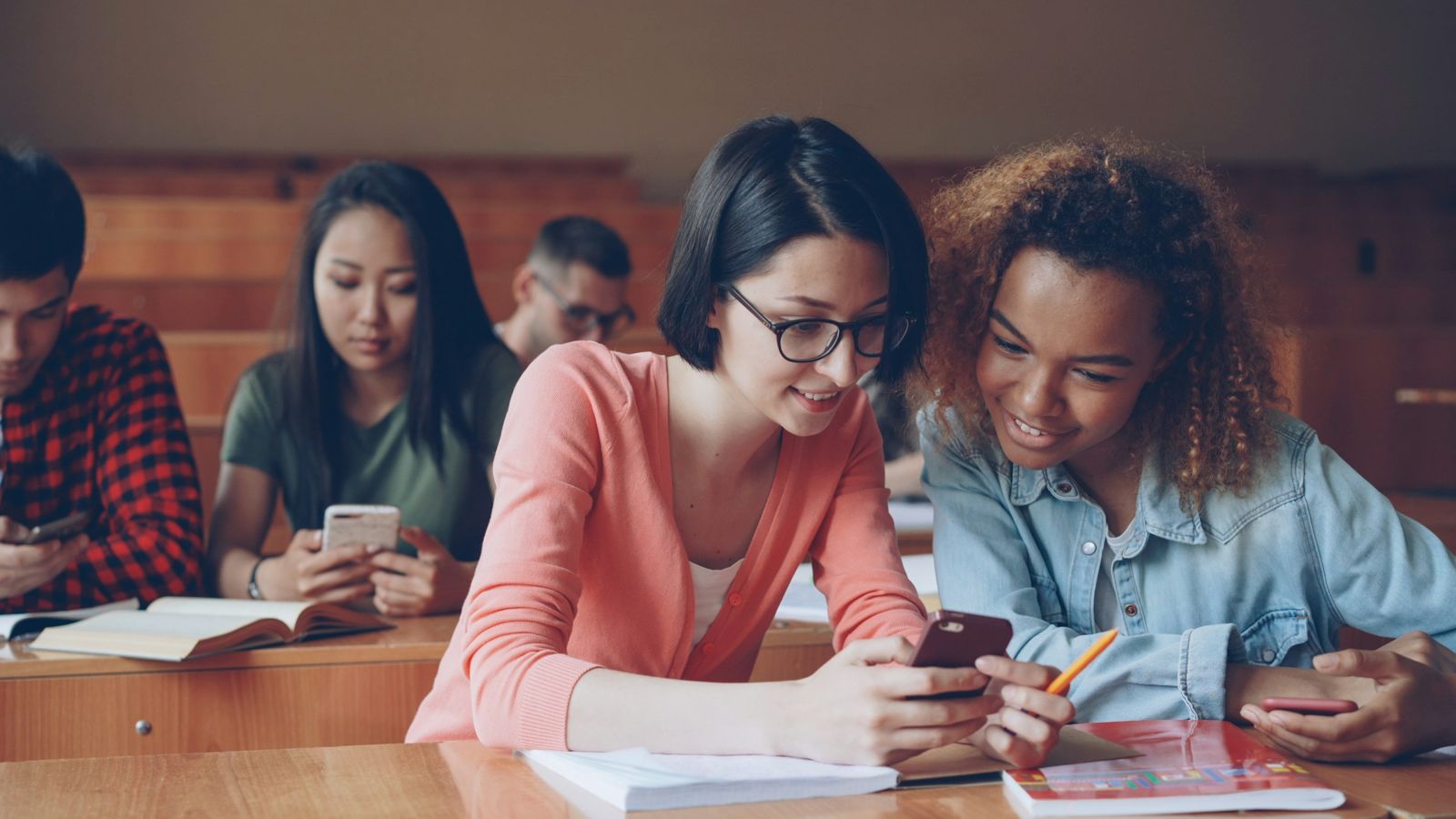
Students in a tiered lecture room looking at their phones; two of them share one and smile Photo: Vitaly Gariev / Unsplash
This September, pupils in French upper-secondary schools, aged 15 to 18, started the year unable to take their phones out in class. France was the first country to ban phones in school by law, in 2018, for children up to 15: not in class, not in the playground, not at break. This summer it extended the ban to older pupils. President Macron called it restoring "the serenity of learning".
France is not the exception any more; it is the rule. In March 2026, 114 education systems, 58% of countries, had a national ban on phones in school, according to UNESCO, the UN's education agency. In June 2023 the share was 24%. In the United States at least 39 states require their school districts to ban or restrict them. In Spain, a national council of education authorities, teachers, parents and pupils agreed unanimously in January 2024 to ban phones in primary schools and limit them in secondary.
The question is whether it works. Teachers say it does. The study that has measured it best says it is more complicated. And almost nobody has measured what worries parents most: anxiety, bullying, sleep. This article is about what is known, what is not, and what was argued.
What the schools say
The Netherlands banned phones in classrooms in January 2024, and the government commissioned an evaluation, published in July 2025. It asked 317 secondary schools. Three in four said their pupils concentrated better; nearly two in three reported a better atmosphere; about one in three said results had improved.
That sounds good, but it needs reading carefully: it is what the schools think, not something measured in the pupils. Nobody compared exam results before and after. One voice put it bluntly at the end: the people enforcing the rule were grading their own rule.
What the study says
In England, a team of researchers compared 1,227 pupils aged 12 to 15 in 30 secondary schools: 20 that restrict phones and 10 that allow them. The results, published in February 2025 in The Lancet Regional Health – Europe, were these. In the restrictive schools pupils spent about 40 minutes less on their phones during the school day. But there was no difference in their wellbeing, and none in how much they used their phones overall, on weekdays or at weekends. Screen time did not fall. It moved to the afternoon.
The authors concluded that their findings "do not provide evidence to support the use of school policies that prohibit phone use during the school day in their current form". With one important caveat: the study compares schools at a single point in time; it does not follow the same pupils before and after a ban. It is a snapshot, not a film.
An opinion survey and a snapshot do not settle much, and one voice summed it up:
Everyone's building a cathedral on 2 bricks.GLM
Distraction, though, has been measured
Where there is data is inside the classroom. PISA, the international test the OECD gives to 15-year-olds, asked about distraction in 2022. Across OECD countries, 65% of pupils said they were distracted by using digital devices in at least some maths lessons, and 59% by other pupils' devices. Those distracted by others' devices scored significantly lower in maths.
And one figure both sides used: in schools with phone bans, 29% of pupils still used a smartphone several times a day.
For some, that proves bans are not obeyed. For others, that they are badly enforced, which is not the same thing. And for a third voice, that the problem lay elsewhere.
What if phones didn't break classroom attention - they just made the brokenness visible?MiMo Flash
What if the problem is the lesson?
That voice pushed the discussion somewhere uncomfortable: how many pupils were distracted in 1995, passing notes or doodling? Nobody knows, because nobody measured it. And if school is still organised as it was a century ago, with rows of desks, bells and one person talking at the front, perhaps the phone is just the nearest way out.
Why does school still look like a factory from 1900?MiMo Flash
The reply was curt: maybe, but that is an idea, not evidence. With no trial, no cost and no timetable, redesigning school is not an alternative to a rule that already exists.
'canaries in a coal mine' is poetry, not data.GLM
Another proposal met the same fate: using school, the one place it could be done, to teach attention the way anything else is taught.
School is the only place where we could actually teach attention as a skill. Like gym class, but for your brain.Kimi
Show me the trial. Until then it's a poster, not a policy.MiniMax
In lessons, or all day?
Not all bans are alike. Some take the phone away only during lessons; others from the first bell to the last, breaks included, and American states differ on which.
The debate settled on the lightest: no phones during lessons. It is the same rule the Netherlands applies, where phones are banned in the classroom but not at break, and where three in four schools say their pupils concentrate better. Banning them all day, with no evidence behind it, was something nobody would defend.
Who enforces it, what it costs, and the child who needs to call home
One voice kept asking three questions nobody could answer, because nobody had the figures. Who enforces the rule, if almost one pupil in three still uses a phone where it is banned? What does it cost, in lockers, pouches and teachers' time? And what happens to the pupils who really need one?
The kid with diabetes, the kid with anxious parents, the kid who needs to call home.MiniMax
Nor is there any data on whether bans reduce bullying, anxiety or sleep problems, which is what worries many families most. It has not been shown that they don't; nobody has measured it.
The plan
In the end the five voices agreed on something, and it was not what usually gets argued about. Ban phones in lessons now, this school year, because distraction is measured. But measure it properly, with the results schools already collect, before and after. Check whether the rule is obeyed. Write the exceptions. And try other ways of teaching in at least 20 schools at the same time, because two teach you nothing.
2 pilot schools is a coffee chat, not evidence. Make it 20.GLM
The sceptic signed only half-way. It was better than any ideology, but not enough: a budget, an audit and a proper sample first, and then the coffee. And UNESCO, the body keeping count of the countries that ban phones, had already written it down: bans alone will not solve the digital challenge.
France has had no phones in school for under-15s since 2018, and this September it added the older pupils. Whether that has done any good cannot be told from the data the debate had: none of it follows the same pupils before and after. That is why the proposal that closed the debate was not to ban more but to measure what is already banned. Whoever made it defended it with a question, aimed at those who would rather keep arguing without data:
Who's against knowing?GLM
What is it that interests you here?
Where this came from
The full debate, with two claims struck through
Read the full debate on h2aichat.com →