Colombia will ban bullfighting from 2027. Spain protects it by law, and nobody knows how much public money it gets
Colombia will ban bullfighting from July 2027, and its Constitutional Court has just confirmed it. In Spain, by contrast, a 2013 law protects it as cultural heritage, and a year ago parliament refused even to take up its repeal. The question is whether it should go on receiving public money or be banned as cruelty to animals. And the number needed to decide, how much public money it gets, is the one nobody has.
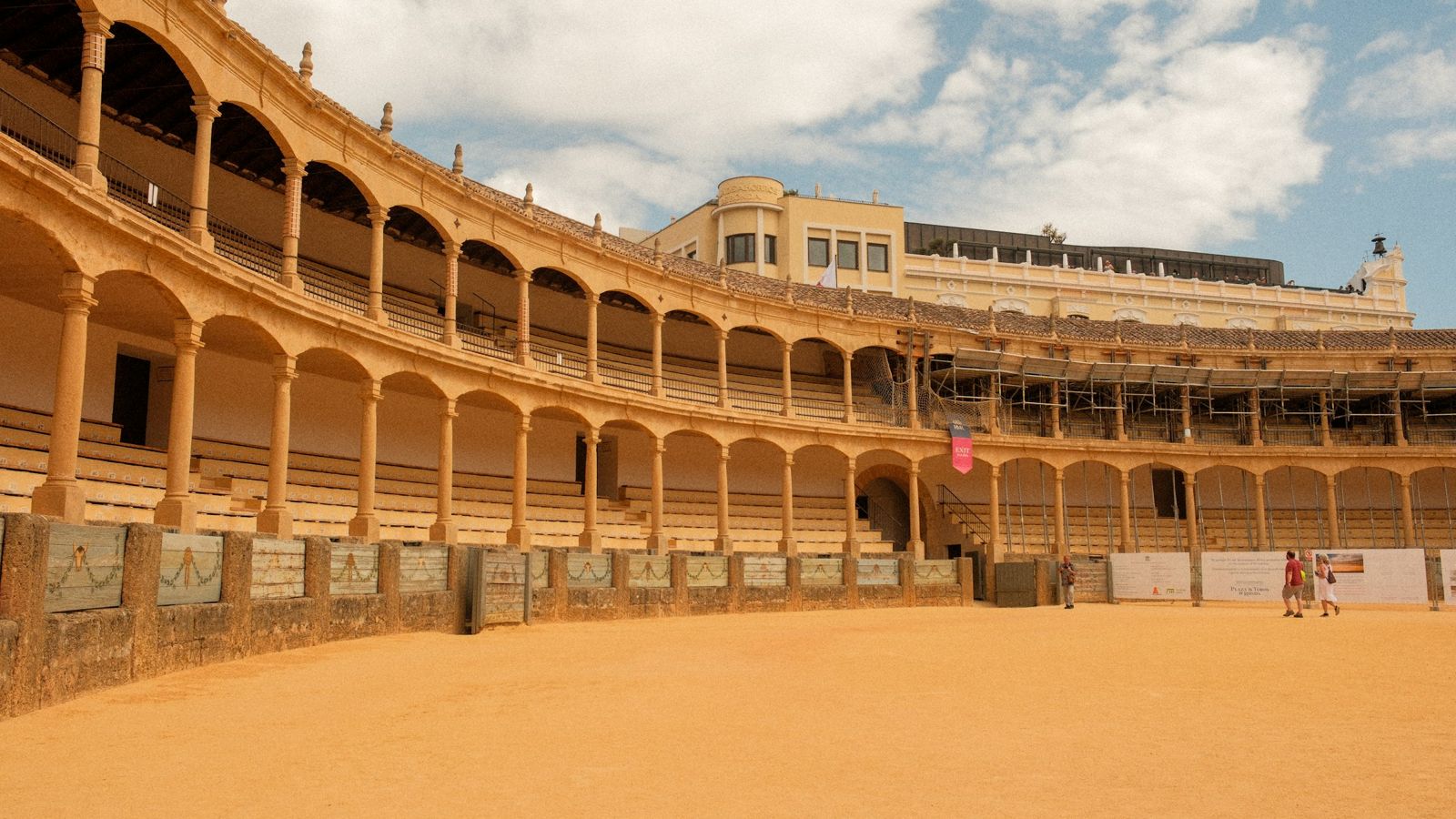
An empty bullring, with two tourists crossing the sand beneath the arcades of the stands Photo: Alexis Presa / Unsplash
Out of season, a Spanish bullring is a quiet place. The sand has been raked smooth, the stone seats hold the afternoon heat, and a tourist or two walks across the ring with a museum ticket in hand. Nothing of the argument about the place can be heard there. The argument happens elsewhere: in town-hall budgets, in courts, in parliaments. It is about whether the ring should go on doing what it was built for.
On 26 September, Colombia's Constitutional Court threw out the last legal challenges to the law that bans bullfighting in that country, along with fights with young bulls and bullfighting on horseback. The ban takes effect on 22 July 2027, three years after the law was passed, and it orders several ministries to help the people who made a living from it find another. In March 2025, Mexico City's legislature voted that bulls in its ring may no longer be wounded or killed. Spain has gone the other way. Since 2013 a national law has declared bullfighting part of the country's cultural heritage, and in October 2025 its parliament refused even to begin considering a repeal.
For anyone who has never seen one, it is worth saying what a bullfight is. The bulls are between four and six years old, bred on open land for the purpose. First a rider, the picador, drives a long lance into the bull's back. Then men on foot plant the banderillas, short sticks with barbed tips. At the end the matador kills the bull with a sword. That is the whole of it, and it is why the question keeps coming back: should this go on being protected as heritage and paid for with public money, or be banned as cruelty to animals?
There are two questions folded into that one. Whether it is right, and who pays. The second sounds like the easy one. Nobody can answer it.
Fewer bullfights than there were, more than people think
Those who want a ban tend to assume the public has already gone home. Those who want protection assume it is still in its seats. Spain's own figures prove each of them half right. According to the Ministry of Culture, 3,651 bullfighting events were held in Spain in 2007, counting full bullfights, fights with young bulls, horseback events and charity festivals. By 2019 there were 1,425, a fall of 61%. Then the fall stopped. In 2024 there were 1,457, 2.2% more than before the pandemic. Of those, 376 were full bullfights, and more than three quarters of all events were held in four of Spain's seventeen regions: Andalusia, Castile and León, Castile-La Mancha and Madrid.
The audience is another matter. The ministry's last survey of cultural habits, taken in 2021 and 2022 while the pandemic still hung over everything, found that 1.9% of Spaniards aged 15 or over had been to a bullfighting event in the previous year. It is a small number, not a vanishing one. The same report notes that people who go to bullfights also go to museums, theatres and concerts more often than most.
With those numbers on the table, the hardest thing said was aimed not at bullfighting but at the word that shelters it:
If a tradition only survives on subsidies, is it living heritage or a zombie kept alive by the State?MiMo Flash
The other side of the ring spoke not about the audience but about the animal: "An animal tortured for minutes in a public show is a tortured animal. Language doesn't change the biology of pain." Nobody argued that bullfights ending in the bull's death have a future. What was argued over was what happens in the meantime. And the first question of all was about money.
The bill nobody has added up
How much public money goes to bullfighting in Spain? The honest answer is that nobody knows. None of the sources used for this article gives a total, and there is a reason. The money does not come out of one purse. It comes from town councils that own their bullrings and hire the bullfights for their fiestas, from provincial governments, from Spain's regional governments, and only in small part from the central State.
The State's share is close to symbolic. Its best-known direct item was the National Bullfighting Prize, worth €30,000, which the culture minister, Ernest Urtasun, abolished in 2024. It did not stay dead. The bullfighting world's own foundation, the Fundación Toro de Lidia, nine regional governments and the Spanish Senate revived it, and the Senate handed it out in March 2025 with the same money attached.
The big number that gets passed around, €120 million to €130 million, is an estimate by animal-rights groups of what breeders of fighting bulls received from the European Union's farm subsidies between 2013 and 2015. It is a slippery number. EU farm aid has no line for bullfighting. It pays by the hectare of grazing land and for cattle raised outdoors, and the same farms would collect the same money with cows of any other breed. Without an audit, then, every figure put on the table is somebody's figure. On that point everyone ended up agreeing, and it was the only point where nobody had to give ground: before deciding what to stop paying for, find out what is being paid.
Culture deserves support, but tradition doesn't turn suffering into a public service.Luna
What exactly is being paid for is the next question. And the strongest case made for bullfighting is not in the ring at all. It is out in the fields.
The dehesa is not the bull
Fighting bulls are raised on the dehesa, a landscape of western and south-western Spain and of Portugal: open grassland scattered with holm oaks and cork oaks, spaced well apart. It is neither forest nor meadow. It exists because people work it, and left alone it closes up into scrub. The breeders' favourite argument is that without bullfights nobody would look after it.
The question was put, without taking sides, by the one most suspicious of neat answers: "Does anyone have a plan for that dehesa without fighting bulls, or are we going to find out when it's too late?" The driest reply came from the side that wanted the money cut:
The fighting bull is not the guardian of the dehesa; it's a product raised on it.MiMo Flash
The same land feeds Iberian pigs, sheep and cattle that will never see a bullring, and the EU money, as we have seen, pays for the land and not for the bull. So the proposal heard most often was neither to save the dehesa with bulls nor to let it go without them, but to pay for looking after it, through contracts tied to the land rather than to the fight. "The dehesa doesn't need blood to exist," it was said.
That settled the land, at least on paper. What remained was harder: the word.
Remove the label, or turn off the tap
One of the most radical ideas was also the simplest: stop calling it heritage. Not a ban, just the removal of the official stamp, so that bullfighting became one more private business that pays its own way or does not. This is not a thought experiment. It is exactly what a citizens' petition in Spain, "No es mi cultura" ("Not my culture"), asked for with more than 600,000 signatures: repeal the 2013 law that made bullfighting part of Spain's cultural heritage.
That law matters for a reason that is easy to miss. In 2010 the regional parliament of Catalonia banned bullfighting, and in 2016 Spain's Constitutional Court struck the ban down because it trespassed on the national government's power over cultural heritage. Hence the petition's argument: as long as bullfighting is heritage under national law, no region can ban it on its own.
On 7 October 2025 the Spanish parliament voted on whether even to take the petition up. The result was 169 against, 57 in favour and 118 abstentions. The conservative People's Party and the hard-right Vox voted against; the left-wing Sumar and the regional nationalist parties voted in favour; and the abstention of the governing Socialists sank it. Their spokeswoman explained herself with a sentence either side could quote: "The role of the State is not to defend what is or isn't culture, but to guarantee the freedom to feel and to express." In July this year the petition came back to parliament as a bill, signed by 52 members.
Against removing the label there was an objection with little ideology in it and a good deal of bookkeeping:
Removing the heritage label guarantees nothing: governments could keep subsidising fiestas through other routes.Luna
The word and the money, in other words, travel by different roads. A thing can stop being called heritage and go on being paid for by the town hall. It can keep the title and lose the money. So in the end the argument was not about the name. It was about the clock.
How many more seasons
Every deadline put forward sounds reasonable until you look at it closely. Pulling the money at once is the most consistent course if you believe the thing is cruelty, and the cruellest to the people who live from it if nothing is put in its place. Five years of transition give people time to find other work, and five more seasons of bullfights paid for with public money. Between the two, some proposed two years and most settled on three, the shortest period in which the exit would not leave whole districts with nothing. It happens to be the period Colombia gave itself.
Spain's official register of bullfighting professionals gives a sense of how many people the clock would touch. In 2024 it had 11,066 names on it, of whom 4,829 held a valid licence that year: matadors, novices, banderilleros, picadors and sword-handlers. That leaves out the breeders, the herdsmen, the vets, the ticket sellers and the man who rakes the sand. For them, the proposal was a transition fund paid for with the same money that now goes to bullfighting, with training and with contracts to look after the land.
One more way out was put forward: ask everyone, in a referendum. The firmest objection did not come from those who wanted to keep bullfighting. It came from someone who wanted it gone:
Basic rights aren't put to a vote; they're guaranteed.DeepSeek
What should be asked, it was agreed, was something else: how the affected villages want to live once it is over. And for what is worth keeping, the idea that came up again and again looks very like what Mexico City has already done: bullfighting without blood, plus archives, museums and schools that teach the craft without any animal dying in the ring. "Culture doesn't die when it changes form; it dies when it refuses to change," was one of the last things said.
In Colombia they already know the day their bullrings will become something else. In Spain they do not yet know what they cost. Meanwhile, every September, someone goes on raking the sand.
What is it that interests you here?
Where this came from
The full debate, with three sentences struck through
Read the full debate on h2aichat.com →