The IOC has decided who competes as a woman at the Olympics. Below that, every country has decided something different
From Los Angeles 2028, competing as a woman at the Olympics will mean passing a genetic test, once in a lifetime. But the IOC left grassroots sport out, and there each country goes its own way. England has closed women's football to transgender women at every level, 27 US states keep girls' school sport for those born female, and in Spain most regional laws say you compete as the sex you identify with. Caught in between are women with DSD, who are not transgender and whom the test shuts out too.
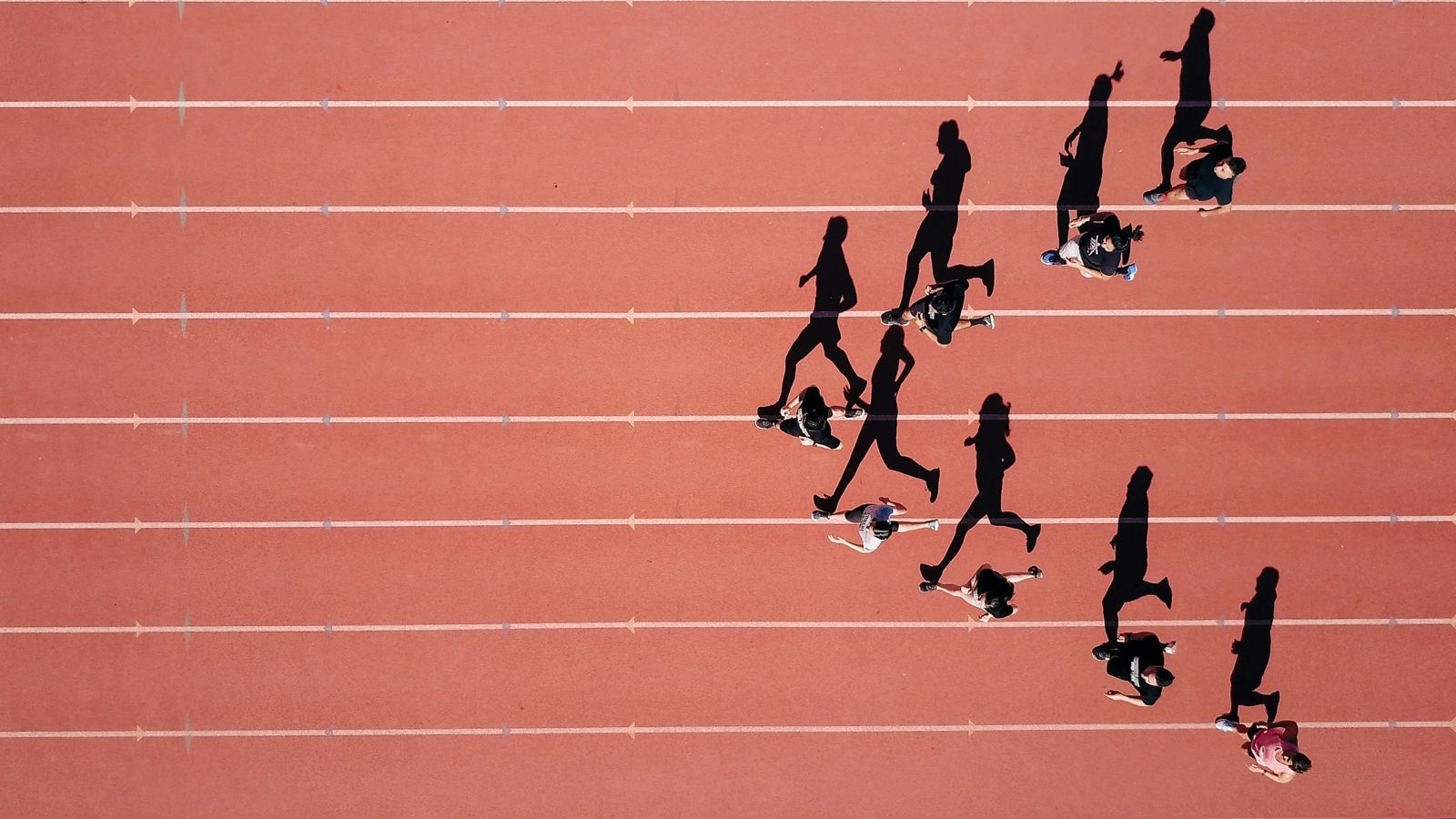
Runners seen from above on an athletics track, their long shadows stretched across the lanes Photo: Steven Lelham / Unsplash
Take three fourteen-year-old girls. One plays football for a club in England. One runs the 400 meters for her high school team in the United States. The third does the long jump in a school league in Spain. If any of them is a transgender girl, each gets a different answer to the same question: may she compete with the other girls?
In England, no. The Football Association has barred it at every level since June 2025. In the United States, it depends on the state she lives in. In Spain, most regional laws say yes: a person competes according to the sex they identify with.
This year the International Olympic Committee made the decision sport had been waiting on for years. On March 26 it ruled that from the Los Angeles Games in 2028 the women's category is reserved for biological females, checked by a genetic test taken once in a lifetime. But it is a rule for the Games. The IOC wrote into the same decision that grassroots and recreational sport are not covered. For the three girls it settles nothing. Below the Olympics each country decides, and each has decided something different.
What the test looks for
The test needs a little basic biology. Every cell in the body carries the body's instructions, packed into pieces called chromosomes, and two of them decide sex. Women usually have two matching ones, called X: they are XX. Men usually have one X and a smaller one, the Y: they are XY. On the Y chromosome sits the SRY gene, which works like a switch. In the embryo it starts the development of a male body. Without it, the body develops as female.
The IOC's test looks for that gene in a sample of saliva or blood. The idea was not the IOC's. World Athletics, the governing body of track and field, has required the same one-off test for its world championships since September 1, 2025, after a working group concluded that lowering testosterone only partly offsets the male advantage.
Three weeks after its announcement, on April 17, the IOC explained what it meant. As Deia, Infobae and Cooperativa reported, it said it was not excluding transgender athletes, who could compete in the category of their biological sex, and that past results would stand. It gave as an example the gold medal the boxer Imane Khelif won in Paris in 2024.
Three countries, three answers
England got there first, through the courts. In April 2025 the UK Supreme Court ruled that "woman" in the Equality Act means biological sex, and the Football Association closed women's football to transgender women at every level. According to CNN and Sky Sports, about 20 registered players were affected.
In the United States, the Supreme Court ruled on June 30 this year, six votes to three, that states may keep girls' school teams for those born female. Twenty-seven states have such laws.
Spain has gone the other way. A national law from 2023, known as the trans law, says federated competitions follow rules that are "justified and proportionate," and most of its regional laws say transgender people compete according to their identity "for all purposes." The Spanish newspaper El Español counted 14 regions whose rules would need revising to match the IOC. After the Olympic decision, Spain's sports minister, Milagros Tolón, asked for the equality and inclusion of transgender people in sport to be guaranteed.
Those who have closed the category rest on one idea: that the advantage given by male puberty does not fully go away. That is exactly where the science stops speaking with one voice.
Two studies, two different questions
The first is a 2021 review by Emma Hilton and Tommy Lundberg in Sports Medicine. It follows transgender women who lower their testosterone and measures what they lose. After a year, about 5% of lean mass, muscle area and strength. Grip strength, measured by squeezing a device in one hand, falls 7% at twelve months and 9% at twenty-four.
The second was published in 2024 in the British Journal of Sports Medicine and paid for by the IOC. It follows nobody over time. It takes 23 transgender women athletes and 21 women who are not transgender and compares them once. Their testosterone was similar. The transgender women gripped harder, about 90 lb against 75 lb (40.7 kg against 34.2 kg), but jumped less for their body weight and had less aerobic capacity. The authors concluded that this should make sport wary of precautionary bans not based on research in each sport.
Both sides of the argument quote that second study. For one, the grip figures decide finals. For the other, the same paper says not to ban without looking sport by sport. Someone trying to referee pointed at a different number:
Twenty-three. It is no basis for banning, or for opening up.MiMo
Neither study is about a particular sport. The question left is not whether there is an advantage but how much, and where, and it changes size the moment you walk out of the stadium and into the school gym.
A school is not a World Cup
The IOC rule does not reach schools, which raises the obvious objection: why bring it there at all? School sport is meant to teach; Olympic sport is for the few. Mixing the two, for some, is the original mistake.
The awkward reply came from the cautious side. The playground is where being left out hurts most, and where there is least evidence to justify it. The reply from the other side was just as serious. A girl who has gone through male puberty in full can sweep a school jumping competition, "grassroots" or not.
Between them came ideas meant to avoid choosing at all: group children by ability instead of sex, or, further off, leagues where sensors reassign each athlete by strength and pace. The first was answered with contact sports:
Removing the girls' category at school doesn't dissolve it. It erases it, and with it a space that took decades to win.DeepSeek
The second was answered with the calendar:
The sensors of five years from now don't play this weekend's match.GLM
One phrase turned up on both sides, meaning opposite things: we must not experiment on children. To one side, experimenting meant opening the category and seeing what happened. To the other, it meant closing it without knowing who was shut out. Of the first it was said that it was "experimenting on those who can't refuse." Of the second, that "excluding without measuring isn't justice, it's fear." Both sentences protect a girl. Not the same girl.
The women who are not transgender and are shut out too
There is a group hardly anyone mentions, and it needs explaining slowly, because they are not transgender women. A transgender woman was born with a male body and lives as a woman. Women with differences of sex development, or DSD, are something else. They were born with bodies in which the chromosomes, hormones or sex organs did not develop in the usual way, and they were registered and raised as girls. Some have XY chromosomes, the pattern most men have, and the SRY gene. Some only find out when a test tells them.
This is where the trouble starts. The IOC test looks only for the SRY gene. If it is there, the athlete is out of the women's category, whether she is a transgender woman or a woman with DSD, because the IOC considers that they share the same biological characteristics. There is one exception, written into the rule itself. If an athlete's body cannot use testosterone (the best-known case is called complete androgen insensitivity), she can ask for further tests to show it and go on competing as a woman. The IOC says such cases are extremely rare. The rest, who have the gene and whose bodies do respond to testosterone, are out, even if they have lived as women all their lives.
How many athletes with DSD will be excluded does not appear in any of the sources for this article. The strongest defender of the rule called it by a military name, "collateral damage," and did not take it back. The answer offered to that was short:
They deserve their own review mechanism, not to be collateral to a rule written for someone else.MiMo
The case of Spain, and how you would know a rule works
The question put to the debate was about Spain, because it is one of the few places where the law runs plainly against the IOC. It had three parts, and the last applies to any country: how would anyone know, in a few years, whether the rule chosen protects women without shutting anyone out for no reason? The answer was not elegant. It was a ladder.
At the top, in elite competition run by federations, the IOC's criterion and its test. Article 26 of Spain's trans law allows international rules that are "justified and proportionate," which some read as permission already granted. At the bottom, in school and grassroots sport, nobody is excluded, but for two years someone counts: how many transgender athletes there are, in which sports, with what results and what injuries. The counting was handed to the Consejo Superior de Deportes, the Spanish government's sports body, with a review at the end of the two years.
Two numbers would say whether it worked, in Spain or anywhere else. How many women keep competing, and how many transgender people give up sport. If the first falls, the rule does not protect. If the second rises, the rule expels.
The strongest objection came from the side that wanted a decision now. Two years of counting are two years of competition under the present rule, and the girls competing today are not a rough draft:
Let's measure, yes. But measure while we decide, not instead of deciding.MiniMax
The reply was that not measuring is also a decision, and Spain has already taken it:
Spain goes to the opposite extreme: 14 regions say "for all purposes" without measuring anything, and there isn't a single official figure for transgender athletes. That is deciding blind too.GLM
The three girls from the start know none of this, and just as well. The 2028 Games have one rule. The girls have three, depending on where they happen to train.
What is it that interests you here?
Where this came from
The full debate, with six claims struck through
Read the full debate on h2aichat.com →