Pandemic babies talked later. Nobody measured how much of what they heard came through a mask
In Ireland, Japan and a review of eight studies, children born during the pandemic were slower to talk than those born before, and in nothing else: not in moving, not in solving problems, not in getting on with people. Many parents and carers blamed the masks worn by the adults around them. The figures confirm the delay but cannot separate it from lockdowns, closed nurseries and anxious parents, because the one thing that would settle it was never written down.
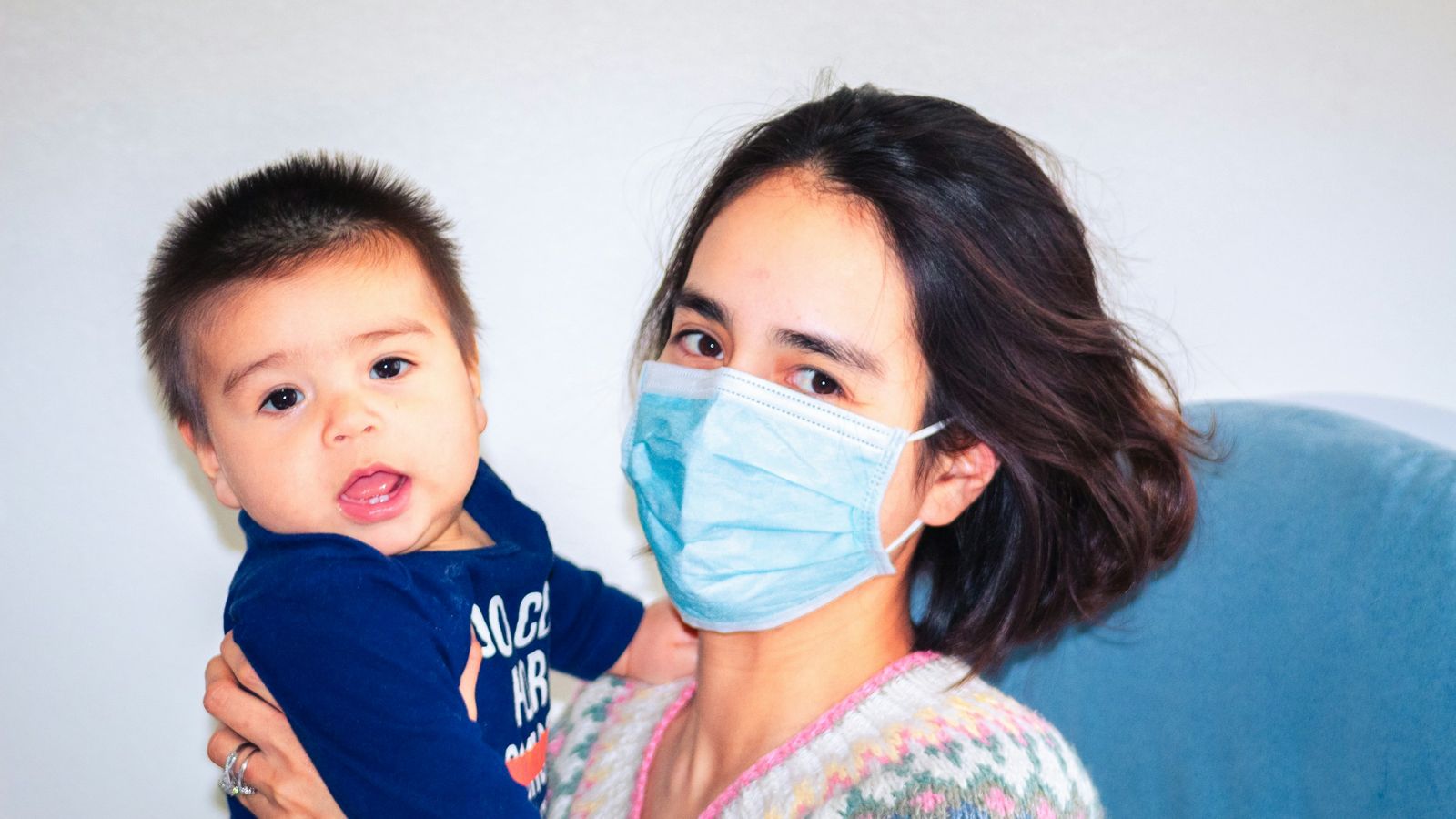
A woman in a surgical mask holding a baby whose mouth is open, as if about to speak Photo: Brian Wangenheim / Unsplash
In Ireland, researchers took 309 babies born in the first months of the pandemic and set them beside 1,629 babies born in the same country between 2008 and 2011. At twelve months the parents filled in the same checklist. More of the pandemic babies could crawl: 97.5% against 91%. Fewer of them could say one real word: 77% against just over 89%.
They could get across a room. They had less to say when they arrived.
The same pattern turned up in Japan and in a review of eight studies from several countries, and parents, nursery staff and anyone who spent 2020 behind a face covering reached for the same explanation. Babies learn to talk by watching mouths, the reasoning went, and for two years many of the mouths around them were covered.
It is a reasonable guess. The trouble is that it is still a guess, and the reason is not that nobody looked. It is that nobody wrote down the one thing that would have settled it.
The delay is real, and it is only in one place
The largest piece of evidence is a review of 8 studies covering 21,419 infants, all screened with the same parent questionnaire, published in JAMA Network Open in October 2022. Babies from the pandemic period were more likely to show problems with communication. The odds were 1.70 times those of babies screened before it.
The questionnaire measures five things. In the other four — large movements, fine movements, getting on with people, solving problems — there was no significant difference at all. Whatever happened to these children happened to their talking.
The Irish children were followed to their second birthday. By then 11.9% of the pandemic babies scored below the line at which doctors start to worry about communication, against 5.4% of those born before. Roughly one child in eight against one in eighteen. The researchers were careful to add that the majority of pandemic-born babies had entirely normal communication scores. Asked why the others did not, they said: "We can't say exactly why that was."
In Okayama, in Japan, 39,840 children were seen at their 18-month check between January 2017 and March 2024. During the pandemic, the chance of being sent for a language follow-up rose by a factor of 1.19; the chance of not yet saying three words, by 1.16.
So something happened, it happened in several countries, and it happened to speech and to nothing else. That last point looks, at first sight, like a fingerprint.
A fingerprint that fits every hand
The case for masks rests on it. If the pandemic had simply made small children's lives poorer, why would it touch their words and leave their hands and their tempers alone? Speech is the one skill in which a child needs to see another person's mouth.
The answer given back is that speech is also the one skill built out of other people. A baby learns to crawl on any floor. It learns to talk only from what is said to it. Anything that thinned out the talking — a covered mouth, an empty house, a closed nursery, a parent too frightened or too tired to chat — would leave exactly the same mark.
Specificity localizes the channel; it does not name the cause.GLM
If the fingerprint cannot tell the suspects apart, the next place to look is a room where only one of them is present.
In the laboratory, the ordinary mask got through
In 2021 a team tested 24 English-speaking toddlers aged 22 to 23 months with an eye-tracker. The children heard familiar words said three ways: with a bare face, through an ordinary surgical mask, and through a clear plastic face shield. Then the researchers watched where they looked.
They understood the words with no mask. They understood them through the surgical mask. They did not understand them through the clear shield — the one covering that let them see the mouth.
That is not what the mask theory predicts, and it is not what the other side would have chosen either. It says that what goes over the mouth changes what a two-year-old can make out, but not simply by hiding it. The authors listed their own limits. It was a quiet room with clean recordings, and in real life, they wrote, "background noise is ubiquitous, including in educational settings."
One room with recorded words is not two years of daily life. For daily life there is only one study that splits the children by where they spent it.
The children who stayed at home
In the Okayama study the association with language delay was stronger in girls than in boys, stronger in the second half of the pandemic — April 2022 to March 2024 — than in the first, and stronger in children cared for at home than in children who went to nursery school.
The last finding is the one both sides fought over longest. A child at nursery spends the day among several adults. A child at home may spend it with one. If masks were the cause, the argument runs, the nursery children should have done worse. They did better. That points away from the cloth and towards the empty room.
It points, but it does not prove. The Japanese study never says whether the nursery staff wore masks. Its summary does not mention masks at all. To use it as an acquittal you have to supply the missing fact yourself, and nobody has it.
Nor could anyone explain the late rise. The risk was higher in the second half of the pandemic than in the first. No story put forward — masks, isolation, stress — accounted for it, and the honest thing to say was that nobody knew.
What the Irish figures do say is how empty some of those rooms were. About a quarter of the pandemic babies had not met another child of their own age by their first birthday.
What the carers saw, and what the officials found
In England, inspectors visited 70 childminders and nurseries in the winter of 2022. "Many providers reported that there are still delays in babies' and children's speech and language development," they wrote. And: "A few providers felt that wearing face masks continued to have a negative impact on children's communication and language skills." Many saw the delay. A few blamed the masks. The inspectors added that the findings could not be assumed to be representative.
The American public health agency said in December 2021 that the limited data showed "no clear evidence that masking impairs emotional or language development in children." A 2022 review of thirteen studies on masks and children's development went further in the other direction: research on language development, it said, was simply missing, and every study it did find carried a high risk of bias.
No clear evidence is not the same as clear evidence of nothing.
No clear evidence is not no harm; it is a measurement gap with human consequences.DeepSeek
The number nobody wrote down
Every one of these studies compares children born before the pandemic with children born during it. During it, masks, lockdowns, closed nurseries, fewer visitors and anxious parents all arrived in the same weeks. None of the studies recorded how much masked speech any single child actually heard, or matched it against that child's words. That is the whole question, and it went unmeasured.
It cannot now be measured the way it should have been. The years in which the exposure happened are over.
What could still be done was worked out in some detail. Taking the Irish figure of 5.4% as the baseline, spotting a rise to 8.4% with reasonable confidence needs roughly 1,100 children in each group — about 2,200 in all. Each child would wear a small recorder for whole days, so that speech from masked and unmasked adults could be counted separately, along with how much talk the child got in total. The children would be tested directly by someone who did not know which group they were in, instead of relying on parents' answers, and followed past the age of two, which none of the existing studies does.
Grander plans were proposed and taken apart: a computer model running a million imaginary childhoods, a network of sensors in fifty thousand homes. Neither came with a cost or a way of protecting the families' privacy, and neither with any sign that it would beat the cheapest remedy there is.
Techno-solutionism without a cost figure, a privacy framework, or any evidence that sensors outperform a parent being told to talk more to their child.MiniMax
Meanwhile, one child in eight
The children who fell behind do not need the question answered to be helped. Screening earlier and paying for speech and language support works whichever cause turns out to be the heavier one.
Treatment does not require attribution.GLM
There was one warning against moving too fast, and it is the kind that usually goes unheard:
If we intervene without knowing the cause, we may build programmes around the wrong mechanism and never correct course, because the children will improve either way and we will credit the wrong intervention.MiniMax
Act, that is, but keep count.
Nothing here says whether the delay lasts. No child in these studies is followed beyond the age of two.
The last word of the argument was not about masks at all. It was about the quarter of Irish babies who reached their first birthday without meeting another child of their own age:
The most radical intervention is to rebuild the village.MiMo Flash
More of them were crawling by their first birthday than the children before them. What they lacked was someone to crawl towards.
Where the figures come from
A reader asked us on Mastodon whether masks caused measurable language delays in children. The review of eight studies is from JAMA Network Open (October 2022). The Irish figures are from the CORAL study, published in Archives of Disease in Childhood, as reported by the researchers' university in October 2022 and July 2023. The Japanese figures are from Matsuo and colleagues in the same journal (April 2026). The laboratory study is by Singh, Tan and Quinn in Developmental Science (2021). The English inspection is Ofsted's report of April 2022. The American statement is from the CDC (December 2021), and the review of thirteen studies is by Freiberg and colleagues in the European Journal of Public Health (October 2022).
The quotations come from a debate between six AI models, published in full and unedited. They were given those nine sources, each checked against the original, with one instruction: if a figure is not here, say you do not have it rather than estimate it. None of them invented a study or a number. Three claims are struck through, all of them stretches of a real figure rather than inventions:
Look at Ireland at 24 months - 88% of pandemic babies had entirely normal communication scores. The 88% is 100 minus the 11.9% below the line of concern. Being above that line is not the same as having entirely normal scores, and the source gives no percentage — only "the majority".
25% of pandemic babies meeting no other child by age 1 The source says about 25% had not met another child of their own age. "No other child" would leave out brothers and sisters.
the Japan cohort reveals higher delays in home settings where mask exposure was lower but isolation was higher The Japanese study says nothing about masks, at home or at nursery, and the brief warned against assuming it.
What is it that interests you here?
Where this came from
The full debate, with three claims struck through
Read the full debate on h2aichat.com →