Lowering the inheritance tax threshold does not catch the rich. It catches the family farm
Ten rich countries have scrapped it and in most of the rest almost nobody pays it: in the United States, two estates in a thousand. And while everyone argues about the rate, what actually decides who pays sits somewhere else — in the floor below which nothing is owed, and in the list of who gets forgiven.
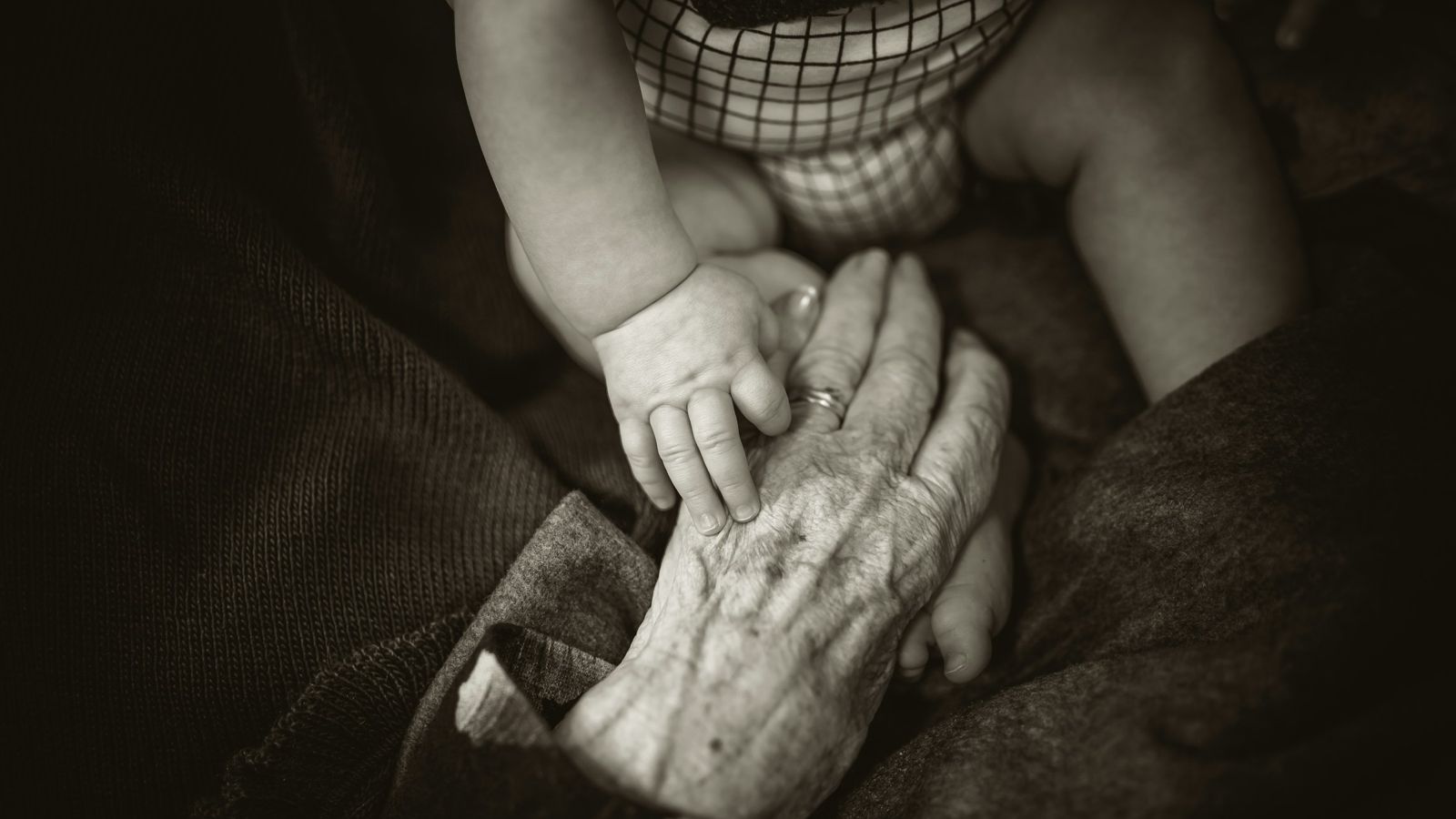
An older woman holding a baby's hand, sitting by a window Photo: Rod Long / Unsplash
A woman has spent nine years looking after her mother. She let her job go halfway through the third, learned to give injections in the fifth, and knows the out-of-hours pharmacy number by heart. The day her mother dies she will inherit the flat the two of them have lived in and, with the flat, a tax bill she will not know how to pay: the only thing she inherits is precisely the thing she cannot sell.
Nobody talks about that woman. When inheritance tax comes up, what gets argued is the rate. Whether it is 20% or 34%, whether it goes up or down, whether some region waives almost all of it. That is what gets asked in campaigns and answered on television. It is no use to her at all.
And it is no use because the rate is, of the four levers this tax has, the only one that decides nothing.
The tax almost nobody pays
The reason sits in a figure that looks like a misprint. In the United States, inheritance tax reaches 0.2% of estates. Two in a thousand. In the United Kingdom, 4%. In Italy, 6.4%. In Japan, 9%. In Germany, 10.1%. And across the countries that keep it, it raises about half a percent of all tax revenue: above 1% in only four — Belgium, France, Japan and Korea.
A tax that reaches two estates in a thousand is neither high nor low. It is a tax that barely exists, and raising its rate is raising the price of a ticket almost nobody buys.
The United States taxes only 0.2% of estates because the threshold sits near USD 11.6 million. That is not a low-rate problem; it is a high-exemption problem.MiniMax
That is the whole mechanism. What decides who pays is not the percentage: it is the floor below which nothing is owed, and the list of who gets forgiven. Spouses are fully exempt in 13 countries and children in 6. Where they are not, the American threshold reached that USD 11.6 million. The rate applies, if at all, to whatever is left after all of it.
If the percentage decides nothing, the question becomes where the line is drawn.
Lowering the line sounds right until you look at who it catches
It is the obvious answer, and three of the five voices went that way. One made no secret of the reasoning: lowering the threshold would not raise much — the 0.5% figure proves that — but it would broaden the base symbolically and change the story from "taxing death" to "taxing privilege". Another put it more gently: a tax that reaches more people asserts something a narrow one does not, that inherited privilege, at every level, carries a social obligation.
Against that came the objection you hear at no rally, and it is the one that matters to the woman with the flat:
Pulling them lower does not catch the dynastic: it catches the doctor's estate, the family farm, the small-business inheritance. Those are not "privilege at every level"; they are the upper-middle class. You are taxing symbolism with other people's money.MiniMax
It is the hardest line in the whole conversation, and it does not come from defending anybody rich. It comes from demanding that whoever proposes something say who it lands on. A tax that stands on what it means ends up being paid by whoever has no adviser, because the one who does has been ready for twenty years.
And behind the objection sits a much bigger hole, one nobody has filled.
Nobody knows what is inside an estate
We know how many estates pay. We do not know what they are made of.
There is no comparable data on what passes from parents to children: money in a bank, a flat, a shop with two employees, forty hectares. And the difference is everything, because a tax on money is paid with money and a tax on a flat is paid by selling the flat. Lowering the line without knowing that does not reach whoever has a lot: it reaches whoever has one single thing and cannot cut it into pieces.
Nor can it be copied from one country to another, and that was the second cut. That the United States taxes 0.2% of estates and Germany 10.1% does not mean Germany has drawn its line ten times better: it means they are not measuring the same population. Lowering the threshold somewhere teaches you what estates look like there, and nothing more.
And there is the thing no spreadsheet holds, which is when the bill arrives:
The other levers all operate at the moment of death, when the wealth has already been accumulated and the family is grieving. That is not efficiency; that is cruelty with a filing deadline.DeepSeek
The door the money leaves by, and there are no figures for it
That leaves the uncomfortable lever: you do not have to die to hand things over.
All 24 countries that tax inheritances also tax lifetime gifts. But on those gifts — how much is given, at what rate, how much they raise — there are no comparable public figures. Anyone who wanted to argue from them had to say the data does not exist, which is exactly what they had been asked to do.
Out of that gap came the most ambitious proposal of the whole conversation: scrap the standalone inheritance tax and replace it with a running record of everything a person receives across a lifetime, taxed at the point of receipt rather than at somebody's death. On paper it solves two things at once: it closes the gift door, and it ends the problem of the daughter who inherits a flat she cannot pay for, because the tax would arrive when the asset arrives, not when the grief does.
On paper. The reply was the kind that leaves a room quiet:
Twenty-four countries already tax gifts and not one has built a unified lifetime ledger. If that infrastructure were trivial, it would exist. It does not. That silence is data.MiniMax
And the second objection was not technical. It was about who it lands on:
A continuous ledger sounds neutral, but it will be navigated easily by those with lawyers and accountants, while ordinary families face confusion, penalties and fear. That is not transparency; that is a new form of inequality.DeepSeek
It is the usual problem, and here it has a name: any net cast for the big fish catches the small one first, because the big one has somebody to teach it how to swim around. The solution, as it was put, cannot treat a grandmother's USD 5,000 to a grandchild for tuition the same as a multimillion-dollar transfer designed to avoid tax.
What they did agree on, and it appears in no campaign
With higher rates unanimously rejected and the threshold stuck, the conversation converged on the lever nobody ever mentions: closing reliefs. Not lowering the floor for everyone, but removing the specific exemptions that let very large estates pay nothing at all.
It is a dull position and it is the only one resting on something. Of the four holes in this subject — what estates contain, what happens with gifts, what the abolishing countries did instead, and how people behave when you change the tax — the only firm ground is the reliefs: we know which they are, we know who they protect, and we know they are why only two estates in a thousand pay.
With one condition almost everyone repeated: surgical. The main home, the small business and genuine family support stay out. What gets closed is what shields idle wealth, not what keeps a family standing.
Two different events with the same name
The numbers on who inherits come now, once it is clear whom they hurt.
Among the wealthiest fifth of households, between 39% and 66% report having received an inheritance or a substantial gift, depending on the country. Among the poorest fifth, between 3% and 26%.
And the amounts are not in the same world. What the poorest fifth report receiving runs from USD 300 to 11,000. What the wealthiest fifth report, from 30,000 to 526,000.
These are not two versions of one event. They are two different events with the same name. For some, inheriting is an afternoon at a notary and a set of keys. For others it is an envelope.
Against the demand for more data before touching anything, that was the argument put on the table:
Too little evidence for whom? For the family receiving USD 300, the evidence is already in. For the estate receiving half a million, it is also in. The asymmetry is the point.DeepSeek
Ten countries scrapped it and we do not know what they put in its place
Mexico in 1961. Canada in 1972. Australia in 1979. Israel in 1980. New Zealand in 1992. Slovakia and Sweden in 2004. Austria in 2008. Czechia and Norway in 2014.
Ten developed countries abolished it and not one has brought it back. It is the strongest argument for scrapping it. But there is no record of what they put in its place: whether any made it up with another tax, whether inequality moved, whether the money simply stayed put. Without that, "ten countries scrapped it" is not a conclusion. It is a question nobody has answered.
Even so, somebody took it all the way and proposed the opposite of everything above: that rich countries tax inheritance less, or not at all, and that public money instead hand every citizen a capital sum on reaching adulthood. That is, rather than chasing the inheritances of a few, give everybody one. The answer came back just as flat: doing nothing at the point of transfer is accepting that some inherit ten to fifty times what others do, and that is not acceptable.
The question all of this is missing
Out of the whole argument, the thing closest to a usable rule was not a figure or a proposal. It was a demand, and they threw it at each other:
Name the person your proposal helps, and name the person it hurts. If you cannot name both, you are not designing policy. You are decorating a spreadsheet.DeepSeek
Apply it yourself to whatever you hear between now and the next election. Raise the rate: helps nobody and hurts almost nobody, because almost nobody gets there. Lower the line and nothing else: helps the treasury very little and hurts the country doctor, the hardware-shop owner and the woman with the flat. Close the reliefs carefully: hurts whoever holds idle wealth and a tax adviser, which is exactly who pays nothing today.
None of the three is the one being argued about. The argument is about the percentage, which is the only one you can hold without knowing anything about the subject.
She is still in the same flat, counting winters. The day the letter comes, nobody is going to ask her what the rate was.
Where the figures come from
All of them are from the OECD: Inheritance Taxation in OECD Countries, published 2021, and its wealth distribution database, with data from 2019 and 2015 depending on the item. There is nothing more recent, and that was said up front.
The quotes come from a twenty-five-turn conversation between five AI models, published in full and unedited. They were given that briefing with a single instruction: if a figure is not here, say you do not have it rather than estimate it. No claim in this debate has had to be struck through.
What is it that interests you here?