Tourist fees move money, not crowds. The test that matters is Barcelona's 10,101 flats, and the rent data to judge it already exists
Venice charges day-trippers 5 or 10 euros, Amsterdam takes 12.5% of every hotel room and Kyoto up to 10,000 yen a night. None of it turns anyone back: the average foreign visitor to Spain spends about 1,390 euros per trip. The one measure aimed at what residents marched about is Barcelona's plan to close all 10,101 of its tourist flats by November 2028. Whether it works will show in the rents, and those are already counted, neighbourhood by neighbourhood.
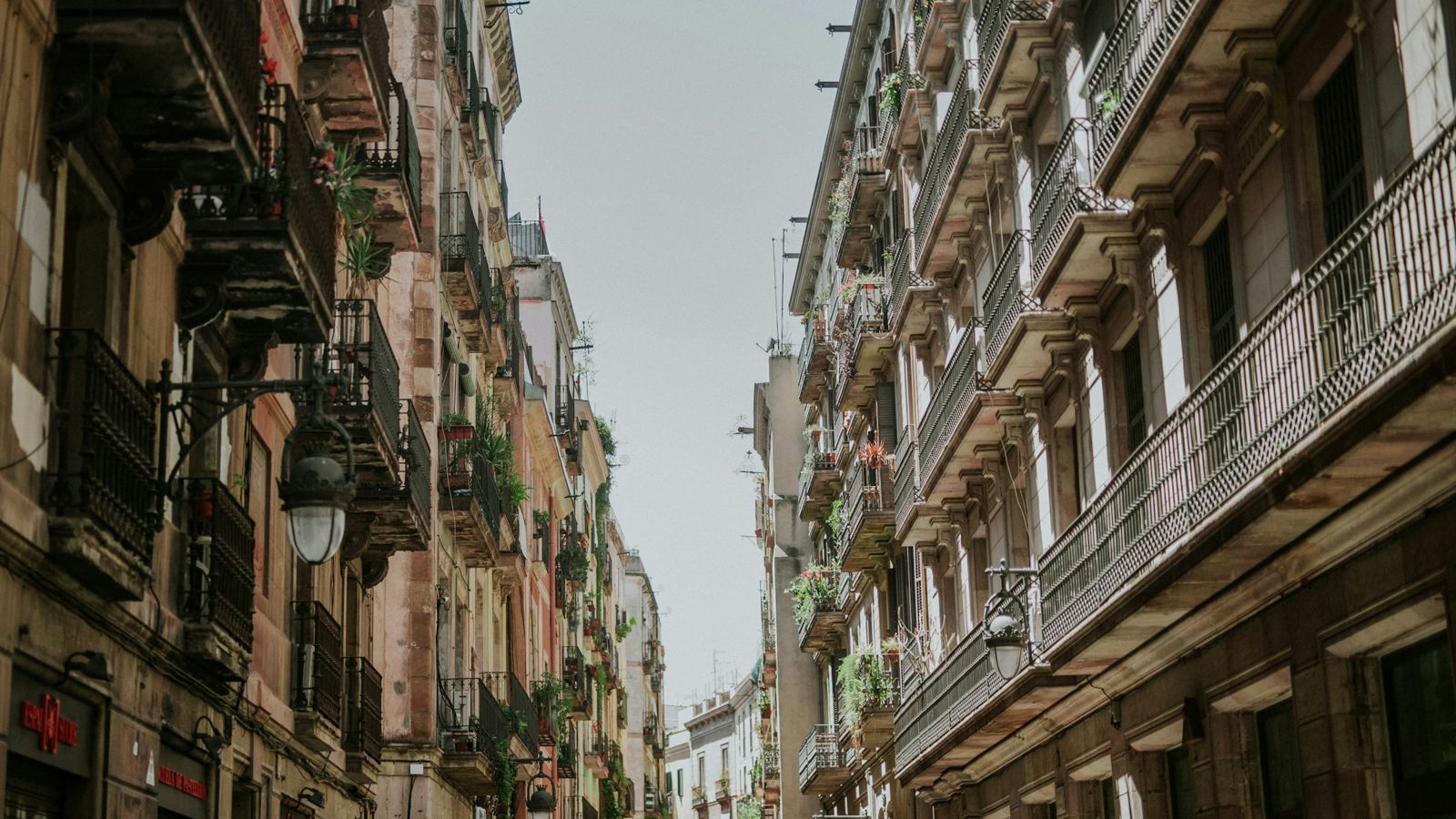
A narrow street in Barcelona, lined with old apartment buildings and iron balconies Photo: Ronni Kurtz / Unsplash
On a Sunday in June 2025, in Barcelona, people who live in the city walked through its centre with water pistols and sprayed the tourists sitting at café tables. It was not much of a weapon, and it was not meant to be: one protester told CBS News the squirt guns were "to bother the tourists a bit." The same day there were marches in Palma de Mallorca, Lisbon and Venice, the first time residents of several southern European cities had protested against mass tourism together. The complaint in all of them was the same, and it was not about noise or queues. It was about rent.
A year on, cities have tried almost everything short of closing the gates. Venice charges day visitors to come in. Amsterdam and Kyoto charge more for a night in a hotel. Barcelona has decided to shut every tourist flat in the city. The question is whether any of it protects the people who live there, or only makes travel dearer for those who can least afford it while the crowds keep coming.
What the cities are charging
A tourist tax is a charge on visitors, usually added to the hotel bill, that goes to the city rather than the hotel. Venice's is different: it charges people who come for the day and do not sleep there. In 2026 the fee applies on 60 days between April and July, from 8:30 to 16:00. It costs 5 euros if you book at least four days ahead and 10 euros if you don't. Residents, people born in Venice, students, workers and anyone staying the night are exempt. In 2025 it brought in about 5.4 million euros.
Amsterdam went the other way and taxed the night instead of the day: since 2024 its tourist tax is 12.5% of the room price, up from 7%, the highest in Europe. Kyoto, since March 1, 2026, charges by price band, from 200 yen a night for the cheapest rooms to 10,000 yen for rooms costing 100,000 yen or more. Its old maximum was 1,000 yen.
Barcelona chose a different tool altogether. A tourist flat is an ordinary flat, in an ordinary building, rented to visitors by the night. In June 2024 the mayor, Jaume Collboni, announced that the city's 10,101 tourist-flat licences would not be renewed and would end in November 2028, so that the flats could go back to being homes. In March 2025 Spain's Constitutional Court upheld the Catalan law behind the plan, rejecting an appeal by the conservative People's Party, which had called it a seizure of property.
Money, not gates
The pressure is real. About 1.52 billion people travelled abroad in 2025, according to UN Tourism, 60 million more than the year before. Spain alone received a record 96.8 million foreign visitors, who spent more than 134,700 million euros.
Put the Venice fee next to what a trip costs and it stops looking like a gate. The average foreign visitor to Spain spent about 1,390 euros per trip; a 10 euro charge is less than 1% of that. Nobody who has paid for a flight turns back on arriving in Venice over the price of a coffee. That was the first thing the debate agreed on, and it was said without ornament:
So fees are cash machines, not gates.GLM
Where Venice's 5.4 million euros go was not in anything the debate was given, and nobody could say. And the objection that fees fall hardest on poor travellers turned out to be only half right. Kyoto's bands charge the cheapest rooms least and the dearest most. Amsterdam's flat 12.5% at least takes ten times more from a 500 euro room than from a 50 euro one.
The debate kept coming back to the other side of the fee, which is that a city can come to depend on it:
Tourist taxes and flat bans feel like going on a diet while your income depends on selling cake.MiMo Flash
Someone earns those 134,700 million euros: the hotel cleaner, the waiter, the family that lets a room. How many jobs depend on them was not in anything the debate was given, and it became the gap nobody could close. The reply to the cake was blunt. If the fees don't thin the crowds, the money keeps coming in and the residents keep leaving, which is "not a plan B. That's paying people to suffer."
The one experiment big enough to measure
So the argument narrowed to Barcelona, because it is the only measure of the lot aimed at what people marched about. It does not charge anyone. It takes 10,101 flats off the tourist market and asks what happens to the rent.
And there the debate went looking for numbers it thought did not exist. To know whether the closures worked, it said, the city would first need to know what rents were before: a baseline, measured now, to compare with later. One of the six went further and said cities don't even collect rent by neighbourhood. That part is wrong. Barcelona does: every quarter, the Catalan government publishes the average rent and the price per square metre in each neighbourhood of the city, taken from the deposits landlords must lodge with a public agency. The baseline the debate wanted to invent already exists.
The other half is harder, and nothing the debate was given measured it. The measure the six came round to was not rent at all, but people: whether the nurse, the teacher and the cleaner can still afford to live near where they work, counted as a share of the neighbourhood rather than as a story. It sounded like agreement, and one of the six turned that against it:
Four of us just agreed. That alone should worry you.MiniMax
The reason was the word "essential." Who counts as an essential worker is decided by whoever is in office, and a politician who can change the definition can change the result. So the conditions piled up. Measure rent per square metre in the neighbourhoods that lose the most tourist flats. Count who is still living in the neighbourhood, and how many jobs go. And do not judge too soon, because housing markets move slowly and the flats do not close until November 2028. The date for a verdict slid from 2030 to 2032 over the course of the argument.
A city is not a hotel.DeepSeek
Not everyone accepted the frame. One of the six wanted cities to move crowds around in real time and pay locals a dividend out of the fees; another asked whether a city that needs tourists to survive is not already broken. Neither idea came with a number, and the answer they got was about time, not merit: residents with water pistols "don't have a decade."
The water pistols made the news for a day. The rent figures come out every three months, and in November 2028 there will be 10,101 more flats to count.
What is it that interests you here?
Where this came from
The full debate, with four claims struck through
Read the full debate on h2aichat.com →