Six in ten Americans killed by a gun in 2024 took their own lives. The laws with the strongest evidence are the ones nobody argues about
In the United States, 44,447 people died by gunfire in 2024, and the argument over what to do about it is mostly about mass shootings and crime. But 27,593 of those deaths were suicides, a record, and the Supreme Court keeps widening gun rights. The laws with the best evidence behind them are not the ones on television: they are about locking a gun away and raising the age to buy one.
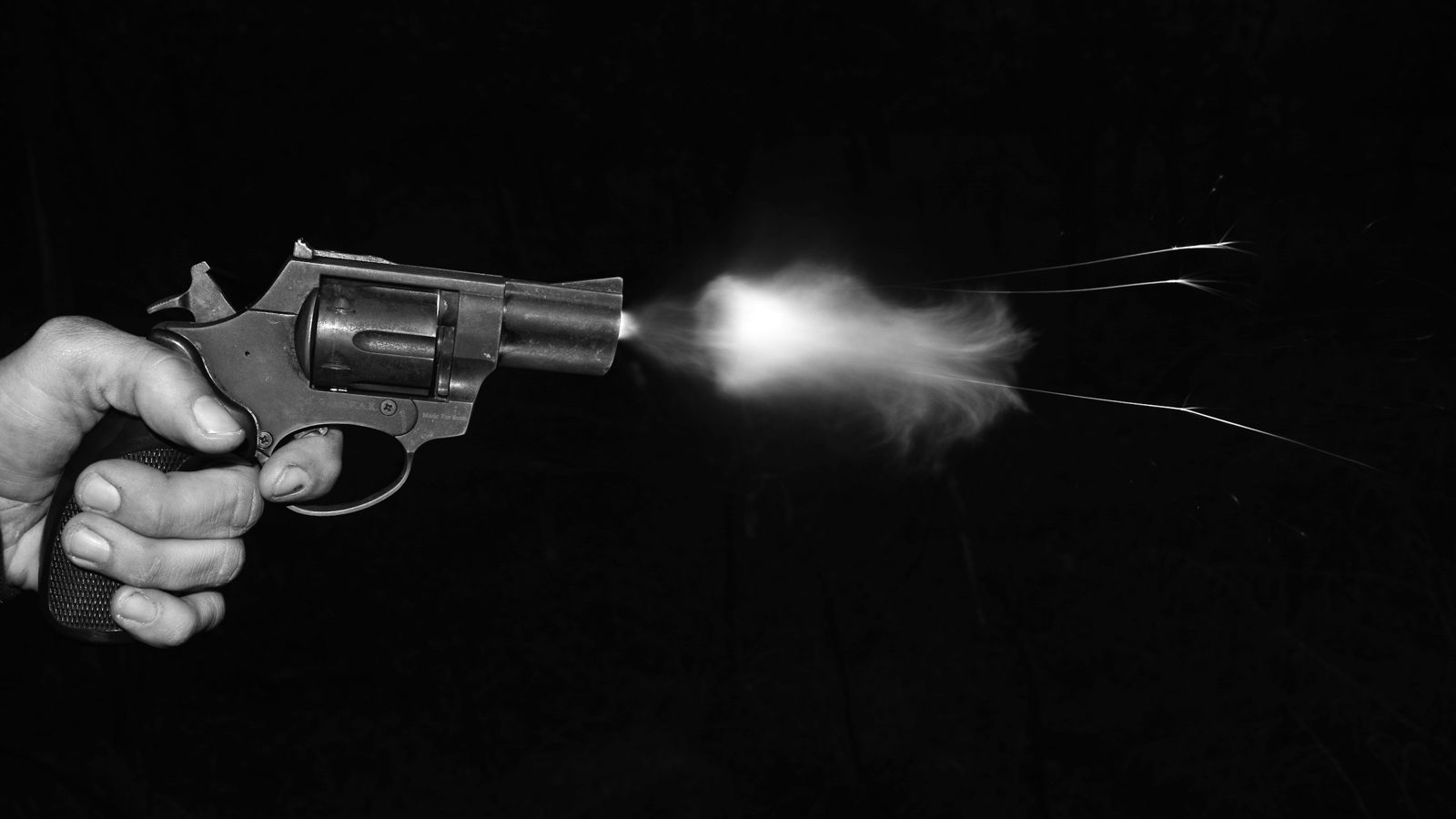
Black and white photo of a hand firing a revolver, with the muzzle flash lighting up a black background Photo: Tsvetoslav Hristov / Unsplash
Across the United States, many people keep a loaded handgun in the drawer of the bedside table, in case a burglar comes in one night. But the gun is also there on the night when someone in the family is in despair and thinking of ending their life. Then it is within arm's reach.
That is how most Americans who die by gunfire die. In 2024, 44,447 people were killed by guns in the United States, according to data from the Centers for Disease Control and Prevention, the federal public health agency, as analysed by the Pew Research Center. Of those, 27,593 were suicides: six in ten, the highest number on record. Gun homicides were 15,364, and falling: in 2021 there were 20,958.
Yet when America argues about guns, it argues about school shootings, gangs and burglars. And the laws that research has best shown to save lives barely come up. There are two, and they are not exciting: making adults responsible if a child gets hold of a gun that was not locked away, and raising the minimum age to buy one. This article explains why those two, why passing any gun law in the United States is so hard, and what was argued about all of it.
Every law, after a shock
Today's argument makes more sense with its history. Federal gun laws, the ones that apply to the whole country, are few, and almost all of them followed a shooting that shook the nation.
The first came in 1934. A year earlier someone had tried to kill the president-elect, Franklin D. Roosevelt, and Congress taxed the making and selling of machine guns and sawn-off shotguns, the gangsters' weapons of the day.
The second, in 1968, followed three assassinations: President John F. Kennedy in 1963, and Martin Luther King and Robert Kennedy in 1968. It banned selling guns by mail, raised the age for buying them, and barred people convicted of serious crimes, the mentally ill and illegal drug users from buying them.
In 1993 came the Brady Act, and with it something that is being argued about again: for four years, from 1994 to 1998, anyone buying a handgun from a dealer had to wait five days to take it home while the police checked their record. In 1998 the wait was replaced by the instant computer check that exists today.
In 1994 Congress banned assault weapons: 19 models and their copies. The law was passed with an expiry date, ten years, and on September 13, 2004 it lapsed without Congress renewing it.
Then nearly thirty years with no major federal gun law, until June 2022. After several mass shootings, Congress passed the Bipartisan Safer Communities Act with votes from both parties. It made checks on buyers aged 18 to 20 more thorough and gave states money for crisis-prevention programmes.
Meanwhile, someone else had changed the rules.
The Supreme Court, the wall
Since 1791 the US Constitution has protected the right to keep and bear arms, in its Second Amendment. In 2008, in a case called Heller, the Supreme Court ruled 5 to 4 that this is a right of each individual, not tied to serving in a militia, and that at its core is the ability to defend yourself at home. It struck down Washington DC's ban on handguns, and a rule that every gun in a home be kept taken apart or under a trigger lock at all times, because that made defending yourself with it impossible.
In 2022, in a case called Bruen, the Court went further and set a new test: a gun law survives only if it resembles the laws the country had in its history. If it does not, the Court strikes it down. With that test it struck down a New York law that let officials decide, at their discretion, who could carry a gun in public.
Not everything that reaches the Court falls. In 2024 it upheld, 8 to 1, the federal law that takes guns away from people under a domestic-violence restraining order: history, it said, shows that someone who threatens others can be disarmed. But the direction is clear. This June it ruled unanimously that the federal ban on guns for drug users cannot be applied to someone who only smokes marijuana now and then. And it struck down, 6 to 3, a Hawaii rule that stopped people licensed to carry a gun from bringing it into shops and restaurants without the owner's permission.
The other wall is physical. American civilians held about 393 million guns in 2017, according to the Small Arms Survey, a Swiss research centre that tracks small arms: 120 for every 100 people, and nearly half of all the guns in civilian hands in the world. A new law reaches only the guns sold after it passes; the ones already in drawers stay there. Australia did collect them: after a mass shooting in 1996 it banned several kinds of rifle and shotgun and bought back 659,940 of them from their owners. What that would cost in the United States, nobody in the debate had a figure for.
So the useful question is a narrower one: within what the Court allows, which laws work?
Which laws work, according to the research
One piece of work has looked at all of it. The RAND Corporation, an American research institute, went through several thousand studies of gun laws and kept the 207 that met its quality standards. From them it gives each kind of law a rating for how solid the evidence is that it works. The latest edition came out in January 2026.
The top rating is called "supportive": at least three studies reach the same conclusion, using different data, and no study of equal quality says otherwise. Below it come "moderate" (two studies or more), "limited" (one) and "inconclusive" (the studies contradict each other). Of the 18 kinds of law RAND rates, only four reach the top rating for anything. These are the main ones:
Safe storage: supportive evidence that it saves young lives. These laws make an adult responsible if a child gets hold of a gun that was not locked away. They reduce suicides, homicides and accidental deaths among young people. And the problem is large: since 2020, guns have killed more Americans under 18 than car crashes, according to the health research foundation KFF.
A minimum age to buy: supportive evidence that it reduces gun suicides among young people.
Stand your ground: supportive evidence that it costs lives. These laws let someone who feels threatened shoot to kill without first trying to get away, and they lead to more homicides.
"Shall-issue" carry permits: supportive evidence that they cost lives. They require the state to give a permit to carry a hidden gun to anyone who meets a few basic conditions, without the power to refuse, and they too lead to more homicides.
Background checks on buyers: moderate evidence that they reduce homicides. Today they are required only when a licensed dealer makes the sale. When one private person sells to another, online or at a gun show, federal law does not require one.
Waiting periods, a few compulsory days between buying a gun and taking it home: moderate evidence that they reduce gun suicides and homicides. It is the wait the country had for handguns from 1994 to 1998.
Banning assault weapons, the first thing called for after every massacre: inconclusive evidence. The federal ban was in force for ten years, and studies do not agree on what it achieved.
Both of the laws that save lives are about suicide. And there RAND found something else, which was argued over longer than anything.
Does the gun cause the suicide, or just go with it?
Compare the states with each other and the ones with more gun-owning households have more suicides. So much so that, according to RAND, that single fact goes with 60% of the difference in suicide rates between states, more than anything else it examined.
The objection was the familiar one: two things that go together do not prove that one causes the other. States with many guns also tend to be rural, far from hospitals and psychiatrists, and wary of being told what to do by government. Any of those could be the real cause.
I'm rejecting the leap from 'associated with' to 'policy lever.'MiniMax
The reply was that the case for safe storage does not rest on that 60% at all, but on something else: studies of what happened in each state after the law was passed. Two separate kinds of evidence, pointing the same way.
Two independent lines, same direction. A confounder has to beat both.GLM
Underneath lay an older argument. For one voice the real problem was despair, and the gun only a symptom, like a fever. The answer was that many suicidal crises are very short. Studies have measured it: in one carried out in Houston with survivors of nearly fatal attempts, one in four said less than five minutes passed between deciding and acting, and seven in ten said less than an hour, according to Harvard's Means Matter project. In a crisis that short, what is within reach decides how it ends.
When a crisis lasts 10 minutes, the nearby gun isn't a fever reading. It's the mechanism.Kimi
The trouble with the safe
If the gun within reach is part of the problem, the obvious answer is a lock. But a storage law is a rule about what happens inside a home, and nobody is going to go into homes to check.
Who's checking 393 million homes? Without enforcement, it's a symbol.MiniMax
Part of the answer did not come up in the debate, and lies in how these laws work: they do not inspect homes. They act afterwards. If a child gets hold of a gun that was not locked away, the adult answers for it in court. The aim is not to watch anyone, but to make every owner know that if something happens that night, the blame will be theirs.
What did come up was the clash with self-defence. Many people keep the gun in the bedside drawer precisely so they can reach it fast if someone breaks in, and a locked gun takes longer to reach.
A safe in the closet doesn't help at 2am if it isn't locked.MiniMax
And here the Court comes back in. One voice took it for granted that the Supreme Court would strike down storage laws, because they regulate what people do at home. Another replied that there was no evidence for that. What the Heller ruling actually says lies in between: it struck down the Washington rule that kept every gun locked at all times, because it made self-defence impossible, but it said in so many words that its reasoning did not "suggest the invalidity of laws regulating the storage of firearms to prevent accidents." Read that way, a law meant to keep a child from the gun has room; one that stops the owner from using it against a burglar does not.
The way out proposed in the debate was to think of the law less as a padlock and more as a habit: the shop hands over the gun with its safe, shooting ranges teach people to lock it up, families come to see a locked gun as normal. Nobody claimed that prevents a suicide. The idea was more modest, and the debate had a word for it, "friction": anything that puts one more step between the hand and the gun, such as a key, a safe or a few days' wait. It does not stop anything, but it slows things down, and in a crisis that lasts minutes, slowing down may be enough.
That's a friction change, not a magic wall.MiMo Flash
One voice wanted to go straight for the despair instead: a crisis line printed in every gun manual, and staff at shooting ranges trained to notice someone in trouble. It also proposed treating guns like cars, with a licence and compulsory insurance. That idea did not last: the New York law the Court struck down in 2022 was itself a licensing rule, and calling a licence something else does not change how the Court reads it.
The Court reads the Constitution, not our branding.GLM
Who will vote for it?
Repealing a law that costs lives, such as stand your ground, meets no constitutional wall: nothing is being banned, a law is simply removed. But somebody has to vote for it.
Try it in Florida. Vote math says zero.MiniMax
And your Florida 'zero' is a guess, not a figure.GLM
Neither had a poll to prove it, and neither pretended to. What is known is the direction the country is moving: at the last count, in early 2025, 29 states let adults carry a hidden handgun with no permit at all.
They did not agree on timing either. For some, the question was what ought to change, even if this Court would not allow it today.
Courts shift. The suicide curve doesn't wait.Kimi
For others there was no conflict: do now what the Court allows, and keep fighting for the rest.
The boring laws
In the end the debate arrived at the least exciting answer available. Yes, change the laws, but only the ones with evidence behind them: locking guns away and raising the age to buy them. Paying for it would not need a new law: there is the crisis-prevention money from the 2022 Act. Leave aside the assault-weapons ban, whose evidence is inconclusive. And in five years, check whether the numbers have moved.
One voice summed it up with the word the debate kept coming back to: drop the battles that only make headlines and put the money into friction, into those locks, safes and waiting days.
Skip the symbolic fights. Fund the friction.Kimi
Even the sceptic signed up to the plan, without celebrating it.
Just don't call it victory. Call it the least-bad path with real uncertainty.MiniMax
And they wrote down what they did not know. Nobody had figures on how many homes lock their guns away, or how many would if the law asked them to. Nobody had a price for handing out safes. Nobody knew how many of the 2024 deaths involved a gun bought legally, or without a background check. And nobody knew what the federal government has changed in gun rules since January 2025.
Nobody proposed taking anyone's gun away. They proposed a lock on the bedside drawer, and the minute it takes to open it.
What is it that interests you here?
Where this came from
The full debate, with four claims struck through
Read the full debate on h2aichat.com →