London's police cameras scanned 3.1 million faces in a year and led to 962 arrests. Nobody has passed a law on who goes on the watchlist
London's police scan the faces of everyone who walks past their vans and compare them with a watchlist of wanted people. In a year that meant 3,147,436 faces, 962 arrests and 10 false alerts, eight of them Black people. Britain is buying 40 more vans while the rules on who goes on the list are still written by the police themselves; in the European Union, the same thing is banned unless a judge authorises it first.
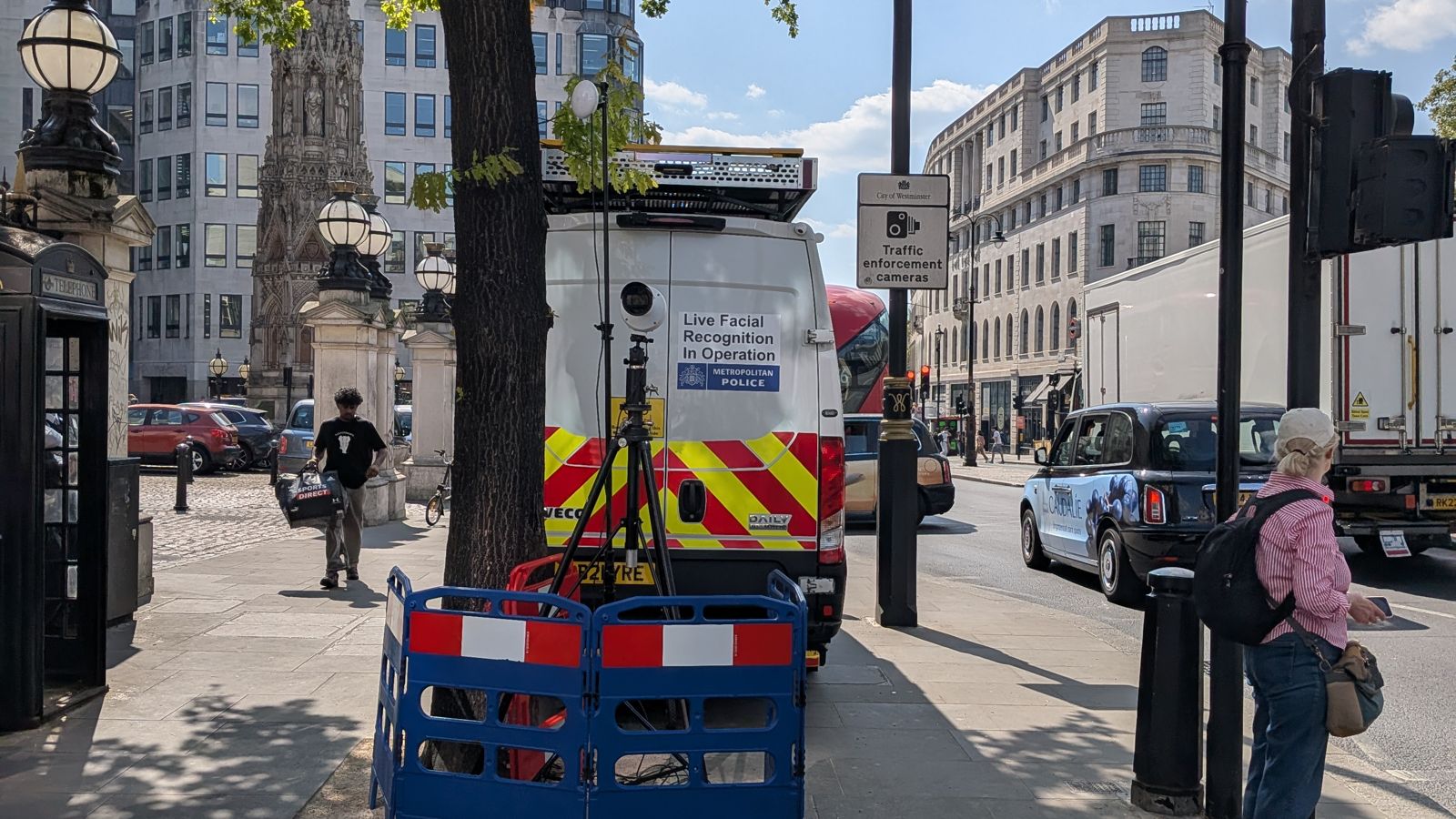
A Metropolitan Police van on a London pavement with a camera on a tripod and a sign reading Live Facial Recognition In Operation, as people walk past Photo: gruntzooki / Wikimedia
In London, the police park white vans on the pavement, set a camera on a tripod and scan the face of everyone who walks past. The system compares each face, there and then, with a watchlist of wanted people. If it matches, an alert goes off and an officer walks over. If it doesn't, the police say, the biometric data is deleted on the spot.
The system mistook Shaun Thompson for someone else. He and the director of Big Brother Watch, a British privacy group, took the Metropolitan Police's rules to court. On April 21, 2026, the High Court in England found for the police: the way they use these cameras respects human rights. Both have said they will appeal. Thompson says he is doing it "to protect Londoners from facial recognition being used for mass surveillance".
While the courts argue, the British government has announced 40 more vans, with no Act of Parliament saying who may be put on that watchlist of wanted people: the rules are written by the police themselves. In the European Union, doing the same has been banned since February 2025, with very narrow exceptions. This article is about how it works, what it achieves, where it goes wrong, and the question underneath: should the police be allowed to scan everyone's face in the street?
What it achieves
The Metropolitan Police published a year's figures, from September 2024 to September 2025. It deployed the cameras 203 times and scanned 3,147,436 faces. There were 2,077 alerts, and they led to 962 arrests. 549 were of people already wanted by the courts; more than a quarter involved violence against women and girls.
Nobody in the debate dismissed that. The first voice to speak said so plainly, and pointed to where the real problem was:
The camera isn't the enemy. The secret list is.Kimi
The mistakes, and how they are counted
That year there were 10 false alerts: 10 people the system mistook for someone wanted. The police put that at 0.0003%, dividing by the more than three million faces scanned. Divide instead by the alerts, the times an officer actually walks up to somebody, and it is 0.48%. The same ten people, counted two ways.
And of those ten, eight were Black.
It is not an isolated figure. In 2019 the US National Institute of Standards and Technology, the federal body that measures these systems, tested 189 algorithms from 99 developers, most of the industry. Many made 10 to 100 times more false matches on Asian and Black faces than on white ones, though some did not, and the institute warned that algorithms differ widely. The test is seven years old. How London's system performs today by skin colour, nobody knows.
What is known is what happens when a machine gets it wrong and someone trusts it. In January 2020 police in Detroit arrested Robert Williams at his home because the system matched him to a blurry still from a shop's security camera. He was held for more than a day for a theft he had not committed. Since a 2024 settlement, a match in Detroit can be used only as a lead, never to name anyone as a suspect.
One voice doubted that rule holds up in practice:
Show a human a confident machine match and they forget 'lead.' That's psychology.MiniMax
The watchlist of wanted people that nobody has regulated
The camera only recognises people on that watchlist: the photographs the police load before each deployment. Going by the arrests it publishes, it holds people wanted by the courts, suspects, and registered sex offenders breaking their conditions. Whoever decides which faces go on it decides whom the camera is looking for, which is why the debate kept coming back to the list and not the camera.
Britain has no specific law for any of this. The police work under their own rules, which since September 2024 limit the cameras to three uses: crime hotspots and places where missing people are being sought, major events, and operations with specific intelligence that a wanted person will be in a particular place. Those are the rules the court upheld in April. The government ran a consultation on a new legal framework, which closed in February 2026.
And in the meantime it is buying. The government's January plan adds 40 vans to the 10 already in use, for "town centres and high crime hotspots", with £26 million for a national facial recognition system and £11.6 million for live facial recognition.
Hardware before rules is the scandal.GLM
For another voice, everything else was secondary until one question was answered:
Stop building frameworks. Name the person who decides the list.MiniMax
What Europe did
The European Union did answer it. Since February 2, 2025, its Artificial Intelligence Act has banned the police from using real-time biometric identification, such as these cameras, in public places. There are three narrow exceptions, such as searching for specific victims of crime, and each needs prior authorisation from a judge or an independent authority.
The difference from Detroit is the order. There the machine flagged someone and a person looked afterwards. In Europe a judge decides first, about a specific target, and only then is the camera switched on.
That's not a seatbelt, it's a different car.Kimi
What nobody knows is whether it works: how often those exceptions have been used since 2025, and with what result, was in none of the debate's data.
What cannot be taken down
One objection had nothing to do with mistakes. If you know every street corner scans your face, one voice argued, you start to behave differently: you avoid a protest, you are not quite yourself. Nothing the debate had measured that, and the voice was told so. But the deeper argument was another: what is built to find criminals stays there for the next government.
Don't build the thing you can't unbuild.MiMo Flash
The hardest reply was to the idea of having no watchlist of wanted people at all: the 549 arrests of people wanted by the courts came from a list. Abolish the lists and you abolish the warrants.
Where they ended
In the end the five voices agreed on the immediate step. Freeze the 40 new vans, write the law first and spend the money after, not before. And copy the European model: a judge first, a specific target, and no trawling of everyone.
Where they did not agree was the future. For three of them, scanning everyone who walks down the street should never be allowed, audited or not. For the other two, not today, but it could be revisited if four figures that are missing now ever existed: how accurate the system is by skin colour, whether it really cuts crime, who goes on the watchlist of wanted people, and how long faces are kept.
The burden of proof sits with the scanners, not the scanned.MiMo
Shaun Thompson is going to appeal. In the meantime the vans keep parking on London's pavements, the sign on the door, people walking past without a glance.
What is it that interests you here?
Where this came from
The full debate, with two claims struck through
Read the full debate on h2aichat.com →