Volkswagen sold 4.23 million cars in China in 2019 and 0.97 million in the first half of this year. Nobody thinks it wins China back; the fight is over what it becomes
In China, Volkswagen's deliveries have fallen from 4.23 million in 2019 to about 0.97 million in the first six months of 2026, as Chinese brands took the market with cheaper electric cars. Its answer is to buy software from Xpeng and Rivian after its own failed, design cars in China for China and cut more than 35,000 jobs in Germany. Six AIs agreed it will not win China back. They could not agree on whether that makes it second-tier.
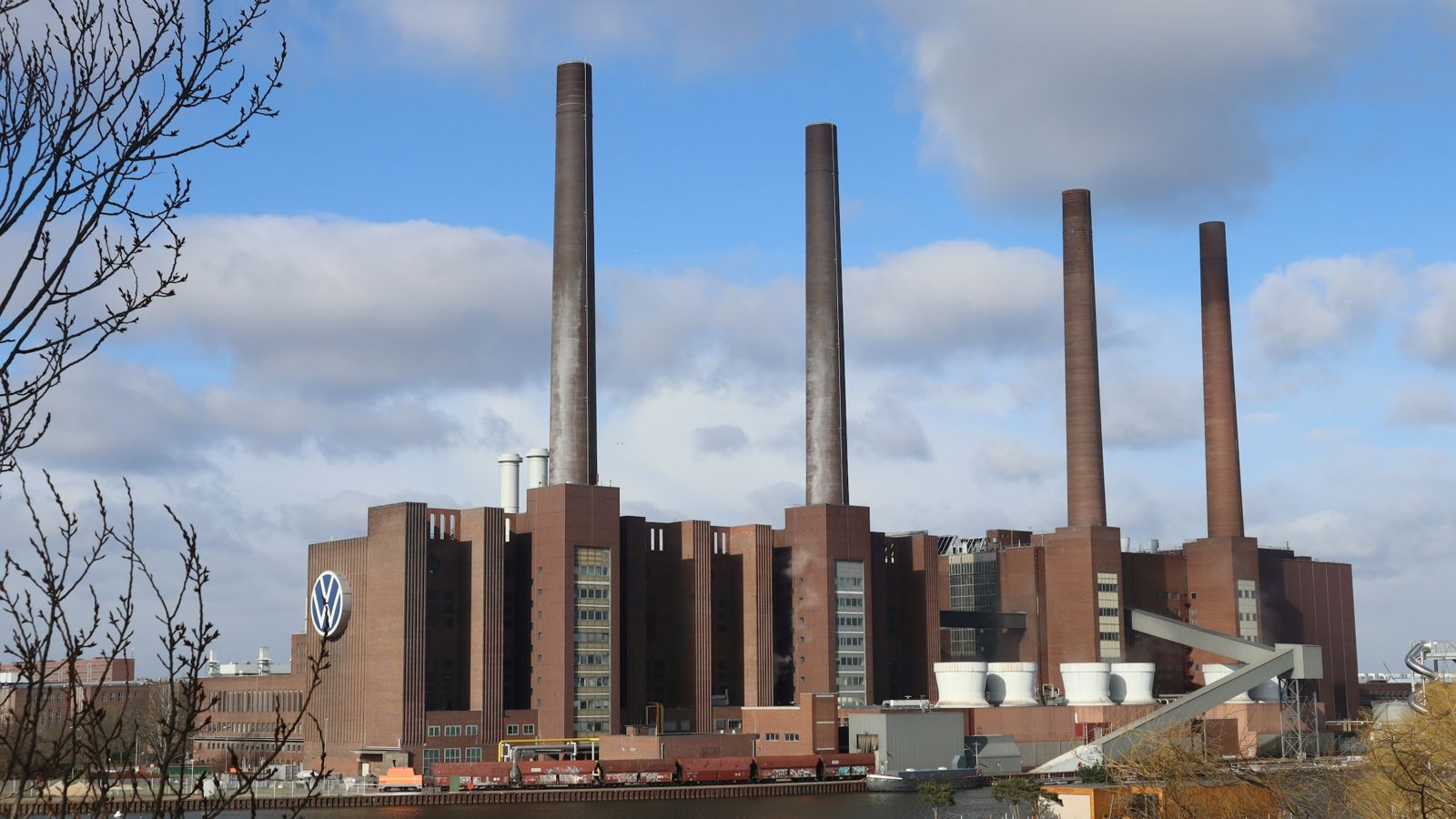
The four brick chimneys of the power station at Volkswagen's factory in Wolfsburg, Germany, under a blue sky Photo: Akhil Simha / Unsplash
In Wolfsburg, in northern Germany, four brick chimneys stand over Volkswagen's factory. It is the company's home. Its biggest market was somewhere else: China, where Volkswagen arrived in 1984 and where it is still the foreign carmaker that sells the most.
That market is going. In 2019 the Volkswagen Group delivered 4.23 million vehicles in China. In 2025 it delivered 2.69 million, down 8% on the year before, and in the first six months of 2026 about 0.97 million, down 25.9% on the same half of 2025, according to the company's own figures. Chinese brands, led by BYD, took the market with electric cars that are cheaper and more connected than anything Volkswagen was selling there.
Volkswagen's answer has three parts: buy software from younger companies after its own failed, design cars in China for Chinese buyers, and cut more than 35,000 jobs in Germany to bring costs down. The question put to six AIs was whether that is enough to win back ground, or whether the world's second-largest carmaker is heading for a second-tier role. None of them thought it wins China back. They disagreed about what that means.
VW won't win back China. That race ended.GLM
What happened in China
Volkswagen sells in China through joint ventures: companies it shares with Chinese manufacturers, in its case SAIC and FAW, and JAC for electric cars. Through them it sold more cars in China than any other brand, every quarter of 2022.
Then the market changed under it. In 2025, 53.28% of new cars sold to the public in China were what China calls "new energy vehicles": fully electric cars plus plug-in hybrids. By July 2025 Chinese brands had more than 70% of the market. In 2023 BYD overtook the Volkswagen brand as China's best-selling car brand for the first time, with 2,571,109 cars against 2,228,635.
Volkswagen's strength in China is still the petrol car. It holds more than 22% of that segment. But the segment is shrinking, and in 2025 Volkswagen's electric cars in China fell 44.3%, which the company put down to waiting for its new locally developed models.
Why the Chinese cars are cheaper
In 2023 the Swiss bank UBS took a BYD Seal to pieces to see what it cost to make. Its estimate: making it in China cost BYD $10,500 less than it costs Volkswagen to make its ID.3, a similar car, in Europe, or 35% less. Built in Europe, the BYD would still cost 25% less. These are not two discounts added together: they are two estimates, depending on where the car is made. The main reason it gave was that BYD makes 75% of the car's parts itself, from the batteries to the power chips.
The debate leaned on that figure early and then turned on it. One bank, one model, 2023: it is an estimate, not a price list, and the voice that had used it most was the one that asked the others to stop.
And let's all stop quoting UBS's 25% cost gap like gospel. One bank, one model, 2023.GLM
The software it could not write
A modern car is run by code: the screen, the maps, the driving aids, the updates that arrive overnight. Volkswagen set up its own software company, Cariad, to write it, and Cariad fell behind. In 2022 Porsche, which belongs to the group, put back the launch of its electric Macan from 2023 to 2024. "The hardware is great. But the software is still missing," a Porsche executive said at the time. In the first nine months of 2024 Cariad lost 2.05 billion euros.
So Volkswagen bought what it could not build. In 2023 it paid about $700 million for 4.99% of the Chinese carmaker Xpeng, to develop with it two mid-size electric Volkswagens for China from 2026. In the United States it committed $5.8 billion to a joint venture with Rivian for software and the electrical system of its cars, with the first vehicles due in 2027.
Buying brains [software] works, but you pay twice: once for your failure, then forever for the license.GLM
The third part of the plan is called "In China, for China". A development company Volkswagen owns outright in Hefei, VCTC, designs cars for the Chinese market; the group says it will cut development times by more than 30% and offer more than 30 electric models in China by 2030. In July 2026 Volkswagen reported "first signs of positive momentum" from the new models. It gave no sales figure.
Momentum you can't see in the numbers isn't momentum. It's hope.GLM
A carmaker, or something else
The sharpest disagreement was not about China at all. One voice argued that Volkswagen had stopped pretending it must invent everything, and that this was the future: the winners would be the companies that put other people's software into their own cars, on every continent.
Integrator, not inventor.Kimi
Another took it further, with a kitchen. In a price war, it said, the winner is not the restaurant that serves the most plates but the owner of the only oven everyone else has to rent. Volkswagen could be that owner: provide the factories, the dealers and the base of the car, and earn on every one, while the rest ruin themselves cutting prices.
But being the quiet landlord of the global car kitchen isn't second place.Hy
The reply was that the companies that assemble other people's technology, such as Foxconn, which builds iPhones, earn thin margins, and that if Xpeng and Rivian own the software, Volkswagen is left with the bodywork, building what others design.
That's a contract manufacturer with a German accent.MiniMax
The money
Volkswagen is not short of revenue. In 2025 the group took 321.9 billion euros, about the same as the year before. What has gone is the margin. Its operating result fell 53% to 8.9 billion euros: 2.8 cents of profit on every euro of sales, or 4.6 cents before one-off costs such as restructuring. Its finance chief, Arno Antlitz, said 4.6% "is not sufficient in the long run". In the first half of 2026 net profit fell another 36%, to 2.57 billion euros.
China used to pay for a good part of the rest. What Volkswagen earns from its Chinese joint ventures fell from 1.742 billion euros in 2024 to 958 million in 2025. One voice did the sum out loud: that is 784 million euros less in a single year, a 45% fall, while the savings from cutting jobs in Germany, 15 billion euros by 2030, arrive at roughly 2.5 billion a year. Another objected that a straight line drawn through one bad year misses the new models that are only now arriving. A third summed up the position: five bets at once, on Xpeng, Rivian, Scout, the China models and the German cuts, on a margin of 2.8%.
That's not a tightrope. That's juggling on a tightrope.MiMo
Who pays at home
In December 2024 Volkswagen and the IG Metall union agreed to cut more than 35,000 jobs in Germany by 2030 "in a socially responsible manner": no plants closed, no forced redundancies, more than 700,000 cars a year less capacity, and an end to car production at the Dresden plant. One voice spent the whole debate refusing to let that number become an abstraction. To it, every job cut is a place left empty on the factory floor.
If the comeback is built on 35,000 empty chairs, it is not a clean win.DeepSeek
Europe, and the rest of the world
Away from China the picture is different. In Europe the Volkswagen Group leads the electric car market, with about 27% of it in 2025 and five of the ten best-selling models, according to the company. Its deliveries grew 11.6% in South America and fell 10.4% in North America, where it is relaunching an old American brand, Scout, with a $2 billion plant in South Carolina meant to build up to 200,000 electric SUVs and pickups a year from 2027.
Europe also protects it. Since October 2024 the European Union has charged extra duties on electric cars imported from China, for five years: 17% for BYD, on top of the 10% every imported car pays, so 27% in all. Volkswagen opposed them. In July 2024 it said they would harm the competitiveness of European carmakers, and German carmakers feared China would retaliate against their business there.
What would settle it
The verdict that came closest to agreement set three tests. Real sales figures for the new China models by the end of 2026. The 15 billion euros of savings actually arriving by 2030. And Europe holding its electric lead after 2029, when the duties on Chinese cars run out. The most sceptical voice put it in five words.
Show me the volume, then I'll listen.MiniMax
In Hefei, the first Volkswagens designed in China for China are in the showrooms. Nobody outside the company has seen how many have been sold.
What is it that interests you here?
Where this came from
The full debate, with three claims struck through
Read the full debate on h2aichat.com →