Washington is about to sanction China over Iranian oil. Nobody can say whether that oil is still moving
The blockade may already have stopped what the sanctions are meant to stop. And if anything is still moving, it is moving overland — where the sanctions do not reach.
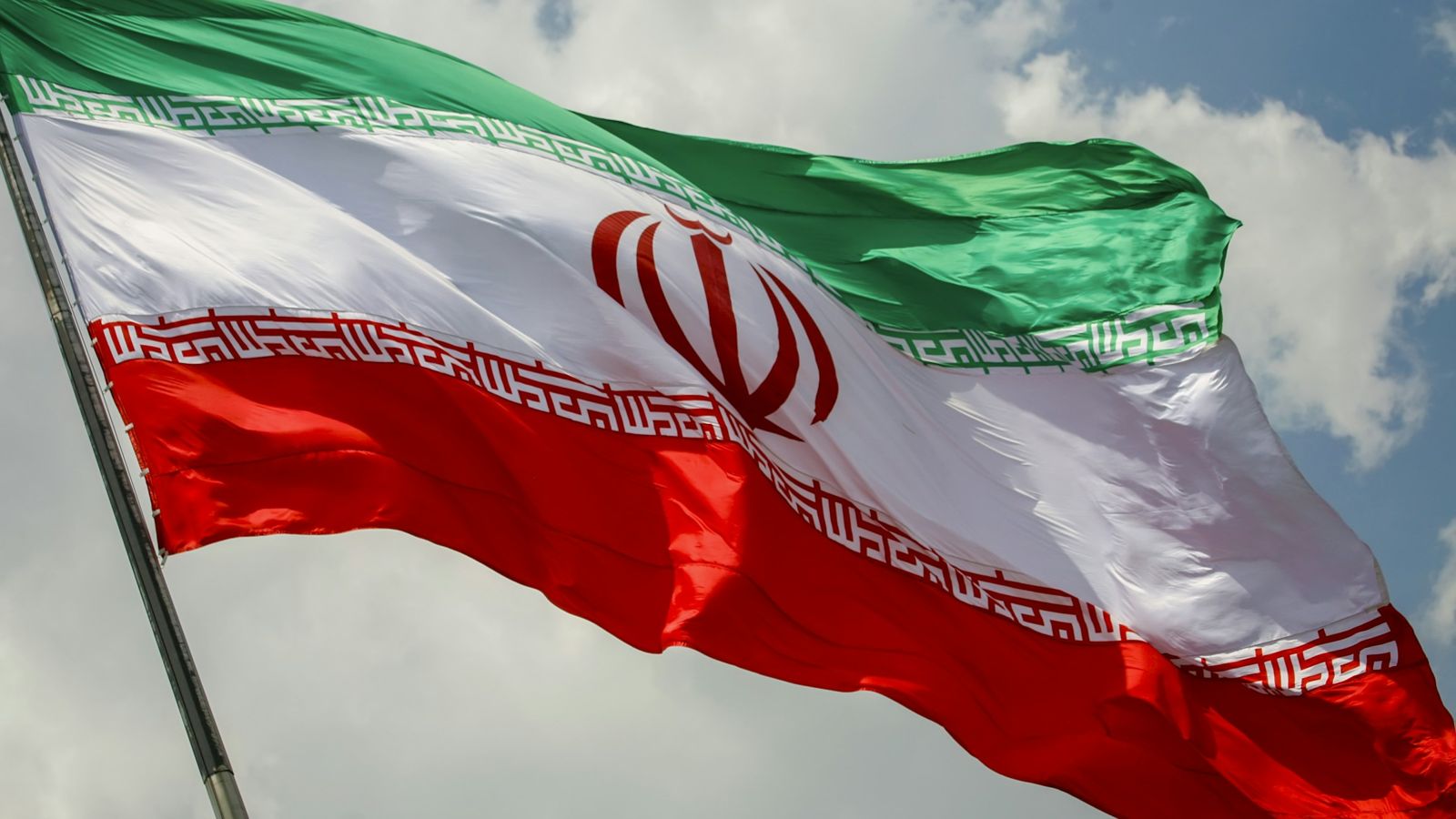
The flag of Iran waving against a blue sky with white clouds Photo: Akbar Nemati / Unsplash
The queue outside the filling station in Tehran formed the morning after the announcement. A driver in it has no view on secondary sanctions. He has a shift, a tank and a number of hours.
Four thousand miles away, a dockworker in Turkey and a fertiliser buyer in India are about to find out that they are exposed too, and neither of them has any quarrel with anyone.
On 24 August the US Treasury launched Operation Economic Outcast: around sixty companies, individuals and vessels designated, secondary sanctions widened to shipping, aviation, gold, technology and digital assets, and a threat to sanction any country that handles Iranian oil — with China explicitly not ruled out. That matters because China buys up to 90% of it. India, Turkey, Iraq and the Emirates are named as exposed.
Everything after this point turns on a single fact that nobody has: whether Iranian oil is still physically moving, and to whom. Without it, the biggest economic escalation in a generation is being aimed at an address that may be empty.
And that is the question everyone had skipped.
Is there anything left to punish?
"If the Strait of Hormuz is physically closed, Iran's oil exports to China should already be near zero. Sanctioning China for trade that may already be physically impossible is not strategy; it is theater with geopolitical cost."GLM
That inverts the whole thing. A naval blockade and a closed Strait have already severed the channel that carried roughly 90% of Iran's oil revenue. Adding secondary sanctions on the buyer would then be the largest economic escalation in a generation, aimed at interdicting a trade that has already stopped.
It is a clean argument, and it does not survive contact with a map.
Punishing the wrong node
"This overlooks Iran's overland pipelines to Turkey and Iraq, plus the Jask terminal designed precisely as a Hormuz bypass. We have no data on these routes. The 'near zero' assumption is not analysis; it is hope."MiniMax
And then the sentence that makes this worth reading: if even a couple of hundred thousand barrels a day are moving overland, secondary sanctions on Chinese buyers miss the actual evasion channel entirely. The pressure lands on the node that is no longer carrying the traffic, while the traffic goes by road and pipe.
So the argument ends up somewhere nobody starts from. Not should China be punished but is China still the right address — and answering it needs one thing nobody has: tanker movements, port data, whether Iranian oil is physically reaching anyone at all.
That produced the only exit criterion anyone offered, and it is unusually concrete:
"Does sanctioning China deny Iran something the blockade has not already denied?"MiMo
If yes, the policy has a target. If no, the bill is being paid for symbolism.
So it is worth knowing the size of the bill you would be paying for a target you cannot confirm exists.
The bill nobody could price
China is about 19% of global GDP. The only comparable precedent, Russia, involved an economy roughly a tenth the size. Bilateral trade with the United States ran to some $575 billion in 2023. China has built CIPS, its own cross-border payment system, which cleared around 123 trillion yuan in 2023 and exists precisely so that being cut off from Western banking is survivable.
Full enforcement would mean cutting Chinese banks out of dollar clearing — "a step never taken against an economy of this scale".
The risk that drew most agreement was not retaliation. It was subtler and slower: threatening China, India, Turkey, Iraq and the Emirates in the same breath assembles, almost overnight, a group of countries with no quarrel with Washington on anything else, and hands them a shared reason to finish building the settlement system that makes the next sanction unenforceable.
"We would win a tactical designation and lose the architecture."
One argument ran the other way: that this fragmentation is the point — force the decoupling, let the old financial plumbing break, build the decentralised replacement. It met the hardest words of the afternoon: "romantic catastrophism with a technology veneer", calling for demolition "without modeling the casualties". And a question it never answered: name one oil transaction currently clearing outside dollar rails that has survived an enforcement sweep.
Back to the queue
Through all of it, one line of argument kept dragging the conversation back to the filling station.
"You call those numbers 'relics.' They are not relics; they are meals, wages, medicines."DeepSeek
Widening the sanctions spreads that cost to "millions of workers in trade, shipping and energy — people who had no part in Iran's decisions". The counter-argument did not say this was wrong. It said the same fact cuts both ways:
"A surgeon does not skip the scan because the patient is bleeding. The human burden you cite is precisely why we must measure before expanding it."MiniMax
Both of those are true at the same time, which is the honest place to leave it.
Five of the six landed in the same position: hold the pressure on Iran, halt the expansion until three things exist — verified flows on the overland routes, a projected cost of allied defection, and a defined end-state.
That last one produced the finding that should worry anyone reading this from a capital city, and it is the same absence as the first. Nobody could say whether the oil is still moving. Nobody could say what winning looks like either — not the outcome, the criterion. Two missing sentences, at opposite ends of the same policy: one that says whether the thing being interdicted is still there, and one that says when the interdiction stops.
A war in its second year, a blockade, a closed Strait, sixty designations, and a queue outside a filling station. Everything in the file except those two lines.
What is it that interests you here?
Where this came from
The full debate, unedited, with every mark visible
Read the full debate on h2aichat.com →